Category: Newsletter

  • CSI Grower Grazier Newsletter – Fall 2014

    CSI Grower Grazier Newsletter – Fall 2014

    Download a PDF version of this newsletter

    ACRES Pre-Conference Track

    CSI is proud to be presenting a (2-day) seminar on Sustainable & Organic Farming at ACRES ECO-AG University Dec. 3-4, 2014. Eco-Ag University is the Advanced Learn-ing program offered through ACRES where attendees can choose a variety of “pre-conference tracks” taught by top-notch consultants, farmers, and professionals who will share their knowledge and experiences pertaining to Eco-Farming.

    CSI’s Dr. Phil Wheeler, co-author of the Non-Toxic Farm-ing Handbook, along with two experienced consulting partners will be presenting the four main approaches to eco-farming: sustainable, biological, organic and energetic.

    The theme surrounding CSI’s intensive two day seminar is “Balancing Minerals and Bio-Activating Microbes.” Beginning with a short history of agriculture and the problems that it has created, attending this seminar will arm growers with the understanding of necessary tools required to achieve harmony with miner-als and microbes in the soil. Covered topic will include: plant structure, soil structure, fertilizers (minerals), microbes, monitoring tools, compost and compost teas, energy broadcasters, and much more.

    Gardeners, farmers, turf managers, and ranchers will benefit by the wealth of knowledge and experience that will be covered. Bringing together the concepts of mineral balancing and bio-activating soils creates synergy in the soil enabling growers to grow more nutrient dense crops and healthy live-stock.

    Don’t miss it!!!
    Register at: http://www.acresusa.com


    Blame it on the Weather

    Written by Dr. Phil Wheeler

    This time you are probably right. We have had enough snow, cold, hail, rain, sleet, flooding, tornadoes, wind, drought and wild fires in the last year to convince even the most diehard skeptics that there is climate change going on. The North Dakota farmers who were previously only able to grow winter or spring grains are now growing corn and soybeans. Regardless of your view on where the CO2 is coming from, prudent people would consider taking steps to mitigate what nature throws at them in the future. In the big picture, balanced mineralization and bio-activation are the only logical steps to prepare yourself for anything that comes along. You can go one step beyond that if you want to consider some sort of energy broadcasting device.

    Recent research shows that the increasing CO2 in the atmosphere will start to reduce the levels of Zinc and Iron in several human food crops. Protein reduction was also observed. These factors will have major implications in terms of future health costs on a world wide basis due to less disease resistance in humans or livestock consuming the depleted food. Food insecurity and water shortages will also play an increasingly larger role in fomenting regional conflicts throughout the world. Mineralized food will continue to be sought by those able to pay for it.

    Let’s look at a series of mitigating procedures and materials that can be used under various weather scenarios. In all cases, you need to prepare for the scenarios by sourcing the mate-rials you might need in advance, so it is just a phone call or email away when the need is obvious. You also need to prepare your equipment to be able to do at least 3 different steps such as tillage, seeding, in-row fertilization, rotary hoeing, weed control sprays, cultivating , side dressing, foliar feeding, inter seeding, excess water draining sprays, etc.

    COLD & DRY SPRING: The dry part has to be somewhat predicted, otherwise you are talking about adding expensive irrigation systems at the last moment. The trick here is to increase your humus levels. If you haven’t been able to make a lot of progress along that line, then fall applications of humates or compost would be called for. Another trick is to apply 20 lb. sugar with Aqua Hold (available from CSI) that will turn the sugar into poly-saccharides, long chain sugars that hold moisture like other carbon sources. This can be applied in the fall or spring with 40-50 gal/water to get it down into the future root zone. This solution might be combined with a chisel plowing to help distribute the polysaccharides. The cold condition will reflect in lack of nitrate release that may prevent any growth or very slow growth. Calcium ni-trate is the product of choice for this situation. (Several liquid calcium products are made with calcium nitrate.) You can use it in the row or sidedress, dry or liquid, at 5-10 lbs per acre. It can also be used as foliar at 2-3 lbs/acre. Foliar feeding has been proven to be a lot more efficient at getting Nitrogen into a plant. It is very strong double growth factor, but it is NOT organic! Organic growers can try using Chilean Nitrate of Soda. This may be hard to source in small quantities, so try the greenhouse grade. There may be some NOP liquid extracts of manures that would have reasonably high nitrates. Fish emulsions or hydrolysates can help, but they generally contain more N in the ammonium or protein form. Always add at least 2 gallons of molasses or 3-4 lbs. sugar for added energy for the microbes. If the plants make it out of the ground, then “Growth Plus” would be an appropriate foliar feed. Adding NutriFoliar would get some additional N, B vitamins and growth factors. Add molasses or sugar as the plant will be struggling with sugar/energy production.

    COLD & WET: The lack of Nitrogen and Phosphorus re-lease as well as low brix should be addressed as above. But now we have the problem of waterlogged soils that squeeze out the Oxygen. A spray of 1-2 pint wetting agent/surfactant/dish soap to help the water go down mixed with 2-3 quarts of 35 % or higher hydrogen per-oxide in 20 gallons of water per acre may do the job. Don’t mix other materials in this mixture as you want as much Oxygen as possible available to plant roots, and not used up oxidizing other materials. If you had your equipment rigged as suggested, you could spray the soil from a front or rear boom while rotary hoeing out weeds and breaking the surface compaction. Although it might seem counterproductive, running a heavy dose of wetting agent through a pivot irrigation system over a flood-ed field might just drop the water fast enough to get back on schedule. All prior activities designed to change structure (mineral balancing), create worm holes (biological activation) and decaying root chan-nels (multi-species cover crop-ping) will pay off under these conditions. If economic plants are out of the ground, begin foliar feeding early with Organo Fish, Sea Crop 16, molasses, compost tea, Growth Plus, etc.

    HOT & DRY: One of the best mitigating materials for hot soils is Ammonium Sulfate. (Regretfully, it is not NOP). When applied at 200 lbs/acre in the fall, (even on alfalfa or clover) the ammonia acts as a refrigerant, keeping the next summer’s soil temperatures moderated. In addition, the sulfate Sulfur in the product is a natural heat stress reliever for plants and livestock. Organic growers can get Sulfur from gypsum (Calcium Sulfate), KS+, Sulfate of Potash, and elemental Sulfur. About 90% of soil tests coming through our lab are short of Sulfur. Your best sources of ammonia for cooling is Organo Fish and the N fixed by legumes or Bioplin (Azotobacter that fix N from the air).

    HOT & WET: Here you can revert back to the wetting agent and peroxide method and combine it with the Sulfur and ammonia sources.

    ALL CONDITIONS: Use the fall as the time to prepare for all contingencies. Get your soil testing done early and take steps to “balance” your minerals. Use Crop Recycle to digest the previous economic crop residue. Plant a multiple species cover crop and fertilize it! Use fish, molasses, milk, numbered fertilizers, compost, etc. Come spring, be prepared with seed treatment and row support. If you have a standing crop in spite of the weather, be prepared to sidedress and/or foliar feed it. [My first rescue attempt in the 70’s was a field of young bell peppers that had been badly damaged by hail. The growing point was still intact, so they responded to a fish and seaweed spray and went on to produce a normal crop.] The big step is to tackle that equipment. One operation per pass of the tractor is wasteful. Two operations per tractor pass is reasonable and three or more is saving you lots of money as well as helping the environment through reduced fossil fuel usage. Get out in that shed and start welding!

    ADVANCED METHODS: CSI offers four types of energy broadcasters that can be used to react to unusual or stress conditions as well as enhancing an already thriving crop under normal conditions. Call CSI to discuss these esoteric methods.

    THINK OUTSIDE THE BOX: Readers of Acres and other modern publications know that the public is spending a lot more on organic, grass fed, artisanal and other designations. They want to know what is in their food, how it was grown, who grew it, etc. If you are anywhere near a city, there will probably be a farmers market. Greens of any type (kale, Swiss chard, mustard, beet, turnip) are big sellers. A few acres of greens or other later season vegetable crops may return a big cash flow if your usual field crops have failed for the season.

    Let’s say you had a total bust on your corn and soybeans. A field full of redroot pigweed, lambsquarters and other odd weeds could be grazed or harvested for silage before it goes to seed. Get a feed test done and market it. If everyone in the area is short of hay, and they have enough sense to realize that the RFV value may be higher that what they have been growing or buying, then it may be a win-win. Or plant a later season crop of Sudan grass for forage silage or buck-wheat or other valuable seed crop. If nothing else after a “bust”, at least plant a 10-15 species cover crop as early as possible in the fall and be the ”eternal optimist” that farmers tend to be.

    (Dr. Phil Wheeler is the Co-Author of the Non-Toxic Farm-ing Handbook. He and the CSI staff will be educating growers during the (2-day) Sustainable and Biological Farming pre-conference track at Eco-Ag University at ACRES, Dec 3-4, 2014. During this (2-day) intensive seminar, attendees will get a complete overview course in eco-farming with a particular focus on Balancing Minerals.


    CSI Office Has Moved

    For the past 20 years or so, Phil and Louisa Wheeler have eaten every meal at home on a small table in the kitchen, despite having a beautiful dining room with oak trim, extraordinary built-in cabinets, and a stunning chandelier hovering over an exquisite dining room table. When they had company, they were forced to eat while sitting anywhere but the dining room table. Why? Truth be known, their dining room table was not covered with a beautiful lace tablecloth, but rather with soil samples, recommendations, computers that generated invoices, and files. In addition, at the “head of the table” lay the legal pad where Phil scratched out hundreds of articles written for CSI’s Grower Grazier Newsletters, ACRES, and many other publications including the book “The Non-Toxic Farming Handbook”. This was not a dining room but rather Crop Services International Headquarters where: the phones rang at all hours of the day and night, large filing cabinets flanked the room, wall decorations included map with colorful pins indicating customers around the world, and a glowing computer screen (not the chandelier) illuminated the room during “non business hours”. In one corner, lay “Bertha”…don’t be alarmed! She was the brains, the network of the three computers CSI Office has moved dispersed like place settings around the table.

    The dining room was the central thoroughfare of the house. In order to get to the kitchen and bathroom you had to cut through Headquarters. Just imagine waking up in the morning with a good case of “bed head” and having to go take a shower. Phil and Louisa had to parade through headquarters to get ready for the day. For many years that included greeting one of the employees who may already be doing soil tests, talking to a client, or ordering a semi-load of minerals to be delivered…and this was prior to the first cup of coffee or a shower!

    Working out of one’s home is a dream for many of us with its benefits: no icy roads to drive to work on, lunch around the corner in the kitchen, no time clock to check in, and the couch is a mere five paces away. With these benefits there are also drawbacks: dinner at a small table, too many sandwiches, too many naps, over sleep too often, the car sits too long and the battery is dead! Phil, Louisa and the employees loved working in this comfortable, clean working environment with good spiritual energy. Phil en-joyed the ability to take an after-noon nap, but he and Louisa spent countless hours at CSI Headquarters helping farmers, gardeners, and ranchers grow more nutrient dense fruits, vegetables and livestock which is what they ate on that small table.

    This year Louisa decided the time was right to have her dining room back! Hence CSI Headquarters has moved to Portage, MI (about 60 miles south). Phil has stepped away from day-to-day operations at CSI, but still is heavily involved with writing, consulting and mentoring remain-ing agronomists, Dane and Joe. The wonders of today’s technolo-gy make it possible for the CSI team to work together remotely. CSI continues its fine traditions…and Phil and Louisa had dinner in their beautiful dining room again!

    NEW ADDRESS:
    Crop Services International
    29246 Lake Street
    Marcellus, MI 49067
    800.260.7933
    csi0926.cldo.com/
    team@cropservicesintl.com


    Like the McRib…Potassium Sulfate is Back!

    By Joe Miazgowicz

    For the past year it has been difficult to find reliable sources of 0-0- 50, Potassium Sulfate, for our legion of growers around the country. Demand has risen sharply world-wide for this great source of naturally occurring Potassium without the Chloride content that is found in Muriate of Potash. Chloride can be very harsh on the soil life and has been known to kill germinating seeds. 0-0-50 is NOP compliant and allowable under OMRI’s generic materials guidelines. Potassium Sulfate has always been pricier than other forms of Potassium, but its efficiency and effectiveness as a source of plant available K usually pays for itself in crop yield and nutritional quality Now, just in time for fall applications of needed mineral amendments, 0-0-50 mining and production is back in full swing and is available in truckload quantities from our Illinois depot. Totes are available, but only from the Utah location. CSI is working to make smaller quantities available for our growers who may need much less than a ton. In fact we are striving to do this with our other bulk minerals. Stay tuned.

    It is wise to consider if 0-0-50 applied in the fall will still be available for your spring-planted crops. If you have a heavy soil (CEC of 9.0 or higher) and the pH is over 6.5, the clay fraction of the soil is already saturated and the Potassium you add has nowhere attach itself. It will have a tendency to leach from the soil with the winter’s moisture. If, however, you have a high organic matter/humus level, then the Potassium can be held in that fraction of the soil un-leachable and will be available to your young spring crops.

    Due to the high demand and interruptions last year in production, the price for 0-0-50 has risen to $848 per ton FOB Morris, IL. We’ve been informed that the price will go up again as of January 2015. Consider your options and plan accordingly. Give us a call if you have questions concerning Potassium Sulfate and how to use it effectively.


    Natural Weed Suppression

    by Dane Terrill

    This is a brief follow-up on the CSI Winter 2014 Newsletter article and a similar article that appeared in ACRES March 2014 talking about Natural Weed Suppression. Dr. Phil wrote “achieving a soil that is so perfectly balanced and bio-logically active as to not have any weed or grass pressure is difficult, but not impossible.”

    Leon Patterson of York, PA doesn’t have perfectly balanced soil but decided to test the concept on five acres of Blue Hopi Corn. This acreage had been strip-mined years ago, but laid fallow for a number of years. The balance of minerals in his soil, and biological make-up of this fallow acreage select-ed for a weedy prairie which required the use of a mold-board plow to break up the sod, and then disced twice to break up the clumps to pre-pare a seed bed. (Dr Phil cited one of the many reasons for seed germination is directly related to sunlight, and with all of the soil disruption many more weed seeds were ex-posed.) Within 24 hours Leon applied the recommended rate of Terra Biotics’ PhosCal 22 (64 oz) along with 2 gallons of blackstrap molasses in 20 gallons of water per acre.

    In addition there were a few other factors stacked against Leon that favored the weeds 1) this field has some compaction issues, 2) time constraints and wet weather patterns kept him from seeding until June 23rd and 3) Phosphorus to Potassium ratio was 1:3. (Dr. Phil mentioned in the article that Dr Ream’s taught that broad-leaf weed pressure is dictated by the ratio of available Phosphorus to Potassium, where 1:1 helped but ideally that ratio would be 2-4:1 to achieve greatest broadleaf weed suppression.) The soil test results of Leon’s soil had Phosphorus (P2O5) value at 72 and Potassium (K) was 235, hence the 1:3 ratio. This soil was primed for weed growth. However, as Leon wrote to me in an email “the weeds lost big time!”

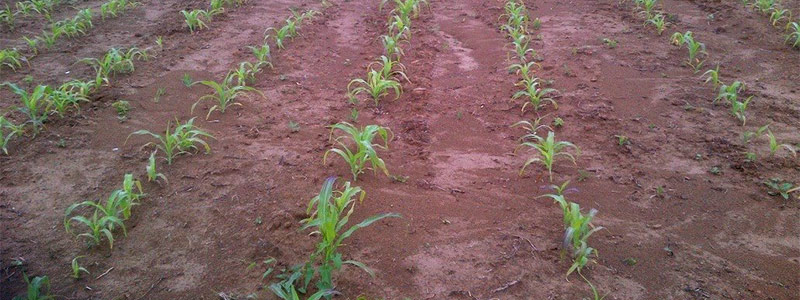
    Hopi Blue Corn was planted 6/23/2014, and the above picture was taken 7/10/14…weeds lost big time! Even more impressive, is that initial plowing and discing (i.e. exposing weed seeds) occurred 46 days prior to the picture. The late stand of corn is the only thing growing in this field.

    The concept of HOW available Calcium and Phosphorus can keep some of those nox-ious weeds in check…is a bit of a mystery! (Dr. Phil explained that weeds are there to do a job; and whether it is to bring Calcium and Phosphorus to the surface, solubilize it, or balance out an excess, Mother Nature has a “Fix”. Conse-quently with ample amounts of those Minerals applied to the seeds on the soil surface, the cash crop wins, and the weeds seeds stay dormant.)

    The writer of this was fortunate enough to be on a crop tour in Washington, PA where Leon was testing this concept. The above picture was taken 46 days after planting and 75 days after discing and PhosCal & molasses application. Leon decided to cultivate the field to incorporate a side-dressing of fertilizer and to take out the few weeds that did emerge. As you can see, there is very low weed pressure. Now, even if a new crop of weeds emerge from the newly disturbed soil, they can be out-competed for available sunlight by the grow-ing canopy of corn. Obviously there is concern this corn won’t mature (105 day corn), but fortunately he was testing a way to take less trips across the field cultivating than worrying about yield with his very late start.

    There have been a few reports from other CSI customers most having moderate to great success when applying Terra Biotics’ PhosCal22 with molasses after any type of soil disturbance to help suppress weed pressure. A few have said they had great success with some weeds, but that other weeds showed up, usually weeds growing from existing tap roots or rhizomes. Calcium and molasses can suppress the emerging growth of these weeds but not eliminate them. The PhosCal and molasses will always favor your economic crop.

  • CSI Grower Grazier Newsletter – January 2013

    BELATED HOLIDAY GREETINGS: Thank You for Your Past Business & we hope you had a great holiday season and we look forward to working with you this year. Good Luck & Good Growing. Dr. Phil, Joe & Sue.

    CHANGE AT CSI: Ron Ward has retired. We wish him well and welcome on board Joe Miazgowicz (Maz΄-go-wits). Joe comes to us from Flowerfield Enterprises, a company built around Mary Applehof’s books including the original Worms Eat My Garbage. Joe is a Certified Soil Foodweb Advisor; he completed advanced training with Elaine Ingham’s Soil Foodweb System. With Joe on board CSI is able to offer new testing services for biological evaluation of soil, compost, and compost tea.

    CSI will also be making a fortified compost blend available to you that has been perfected by Joe which you can now use directly as your “tea bag” no matter your brewer size. CSI will also have very efficient, but inexpensive, proven brewers if you wish to get into the compost tea paradigm with low cost, no hassle, and limited time involvement. On-site consulting services for setting up compost and compost tea production will also be available.

    New Microbial Services and Why!

    Here is a more detailed explanation of CSI’s new services in Joe’s own words:

    First of all, I am proud to become a new part of the great tradition here at CSI. I have known and worked over the past several years with Dr. Phil and Louisa, Sue Hartman, and of course, retired Ron Ward. I am happy to bring what I have learned of soil biology, as well as compost and compost tea technologies, to add to the CSI line of products and services.

    CSI’s methods have always centered on soil testing for mineral balance and nutrient availability. Now we are adding biological assessments of soils, composts, and teas. “Qualitative Analyses” testing is based on examination by microscope of your samples to estimate the population, diversity, and quality of the bacteria, fungi, protozoa and nematodes that inhabit the soil and perform much of the work of making nutrients available to the crops, trees or other plants.

    Biological soil analysis of this sort gives the grower a baseline from which to gauge the soil’s progress. This baseline will include a fungus to bacteria ratio. This is important since some crops will prefer soils with fungal dominance; others will prefer bacterial dominance, and many prefer the balance to be relatively even. This knowledge will affect the choices of amendments we recommend.

    Composts are examined the same way, but here the emphasis is on the density and diversity of the microbes. Compost’s ability to build organic matter, to sequester and release nutrients and moisture can be predicted. Compost tea makers can use this test to check the quality of the compost they plan to use in their brews.

    Testing liquid samples, whether an Aerated Compost Tea (ACT) or a Liquid Compost Extract (LCE), is a shorter, simpler process that can gauge the effectiveness of the brew. ACT is a liquid compost extract that is continually aerated for 18-36 hours with microbial foods added to greatly increase the populations and activity of the microorganisms. ACT is very effective as a foliar feed all by itself. It is also a great vehicle for other foliar treatments. It aids in the survivability of the microbes and nutrients on the leaf and other plant surfaces, providing improved disease and insect protection.

    After 24 hours of high aeration and with microbial foods added, an Aerated Compost Tea will have much higher populations of very active microbes. Active bacteria and fungi produce compounds and adhesives that keep them from being washed off in foliar applications.

    CSI’s new “Brewer Blend,” is a handcrafted blend of compost especially formulated for brewing Compost Teas and Extracts. We will ship the special compost to our growers with instructions on how to activate the compost for effective brewing. Guidance in preparing different recipes for different plants, time of the year, or other situations will always be a part of our continuing grower support program.

    LCE is a liquid extraction of the microbes from the compost into a water base. Since there are no extra foods added LCE can be stored for a few days before it must be applied. Soil drenches of larger plots are more easily accomplished with Liquid Compost Extract as production time is shortened (only an hour or two) and the volume output per day can be much greater. In addition, LCE soil drenches are better at bringing the full diversity of microbes from the compost in the tea bag directly to the soil.

    Finally, CSI is now offering an efficient, low-cost compost tea brewer, the Bio-Brewer, for our customers. Designed to fit the standard 275-gallon ribbed plastic tote, this brewer has been tested thoroughly. It produces enough aeration/oxygen to keep even extremely microbe-rich brews from going anaerobic. The brewer is easily cleaned and all the parts including the blower are easily serviced or replaceable at low cost. The brewer has a custom-made compost extraction basket that can be removed, making the unit useful for mixing many of the soluble powders and liquids that CSI recommends for various growing needs. We are also offering a 5-gallon compost tea brewer for smaller growers and greenhouse operators; this brewer can create enough tea to treat up to a quarter acre of soil or an acre of foliar application. Other brewers (30gal, 50gal, 100gal) will be available in the coming months.

    I am excited to be bringing these new products and services to the CSI customers CSI. Here’s why…

    Did You Ever Wonder How Forests Turn Themselves Green Every Spring Without Adding Any Nitrogen Fertilizers?

    Mother Nature and millions of years of evolution has produced a growing system that works in every corner of the world and does not need man or his inputs. Plants developed photosynthesis, a process of transforming sunlight into sugars, carbohydrates, and proteins. Some of this “food” is stored in the plant to help fund the plant’s growth, but 40-60% of what is produced this way is sent through the roots and into the soil (root exudates.) The plant does this to attract bacteria to the root zone to feed on the free munchies. Bacteria have a Carbon/Nitrogen ratio of 5-1 making them the most Nitrogen dense living organisms on the planet. So the plant is attracting Nitrogen to the root zone; but the Nitrogen in the bacteria is unavailable to the plant.

    This is where the microscopic creatures called protozoa do their thing. Protozoa are predators of bacteria; however, they have a very different Carbon/Nitrogen ratio of 30-1. This means that in order to get 30 units of Carbon from the bacteria, a protozoa will need to eat 6 bacteria. This will leave him with 5 extra units of Nitrogen that he just doesn’t need. When the protozoa excrete the excess N, the Nitrogen has been transformed into a soluble form that is quickly taken up by the nearby root hair. Since each protozoa can consume about 10,000 bacteria per day, and there can be 50,000 protozoa in each gram of soil; there will be plenty of Nitrogen available for the plant.

    Fungi…The Mineral Suppliers!

    Bacteria consume and metabolize the minerals in the soil around them. Protozoa, nematodes, microarthropods, etc. eat the bacteria and poop out waste products containing small amounts of these minerals in soluble form for the plant roots nearby. These amounts are not near as great as the amount of Nitrogen released this way, because the bacteria themselves are about 20% Nitrogen. The primary movers of minerals from the sand, silt, and clay of the soil are the fungi.

    Mycorrhizal fungi actually invade (grow into plant cell walls) of most plants and receive sugars, carbs, and proteins directly from the plant. In return, the plants receive the nutrition they need from the solubilized minerals that the fungi scour from their surroundings, effectively expanding the root zone for the plant. (Fungi can bring a plants missing mineral from hundreds of feet away!)

    Other fungi that do not invade the root, do colonize around plant roots and partake of the plant’s root exudates provided for them. These fungi will exude some mineral compounds in the plant root area but when the fungal strands die off from time to time or are eaten by bacteria and nematodes, etc. they will release a lot of minerals around the roots. Since much of the cell wall structure of the miles and miles of fungal strands are made up of Calcium, having a good fungal biomass in the soil around plants will help ensure constant and adequate Calcium resources for the plant.

    Today’s agricultural practice (fertilizers, herbicides, pesticides, tillage and GMOs) can disturb this natural system of nutrient cycling. Inorganic fertilizers are basically salts that dry out the bacteria that congregate around plant roots. Herbicides and pesticides kill much of the beneficial microbe population. Tillage rips apart the extensive fungal networks in the soil, and GMO plants can produce altered exudates that will not attract the soil life or feed them properly. With low populations and less diversity of “worker” microbes in the root zone, the crop needs the farmer’s input of soluble plant food. These salts further diminish the soil life creating an ever-growing chemical dependency.

    We can use this knowledge of the importance of microbes to improve a field that is regularly running out of mineral nutrients. CSI recommends boosting the life in the soil with applications of Organic Fish, SeaCrop 16 (seaweed) and molasses that feed the microbes whom shuttle nutrients to the plants. We also recommend microbial packages that can perform specific functions such as Nitrogen-fixing or disease suppression to boost this year’s crop without adversely affecting the other life forms. These cultured microbes represent less than 1% of all the species that live in the soil and on the foliage. So in order to replenish the whole soil foodweb we now suggest inoculating the soil with high and diverse populations of microorganisms by way of compost and especially compost tea. This way we can re-establish the proper biological balance and achieve a self-sustaining crop year after year – just like in the forest.

    WHY WE RECOMMEND THE PROCESSES AND PRODUCTS THAT WE DO:

    We spend hours each day talking to growers that call in from all over US & Canada and a few from overseas. They usually have had a recent soil test and need some help understanding what the test is telling them and why we are making the recommendations that they have in front of them. Even though most of CSI’s theories of how to recover a soil are in the Non-Toxic Farming Handbook and on the internet at our website in years of back newsletters, we as humans can only retain so much. We need reminders of what concepts should guide our decisions concerning “recovering” our soils which is another way of saying that you are converting to more sustainable or organic practices.

    Since minerals are the basis of life, it makes sense to deal with them first. It is amazing and perhaps disconcerting to see that nature is able to produce foodstuffs of all types even though the end product is not fit to eat because of the lack of minerals. Actually it is humans that allow this by using toxic rescue chemistry to bring sub-standard crops to harvest and then onto our plate. Dr. Albrecht’s CEC (Cation Exchange Capacity) method of mineral balancing techniques has proven the concept all over the world. However, we also know that healthy food can be grown with reasonable balances at less than optimum levels or through the use of low level, immediate applications of minerals in starters, sidedresses or foliars.

    We suggest you start out correcting the calcium first. Lime is the cheapest fertilizer available. A recent article is Graze, Vol. 19, No. 9, Nov. 12 stated the following, “A dollar invested in a calcium-based fertilizer program on the dairy grazing paddocks of a California research farm produced an estimated $1.55 in additional income with most of that additional profit coming from the improved forage quality”. Yet you still have beef graziers putting out articles to the affect that the manure, urine and hoof action is all you need to recover your soil, produce nutritious forage and raise nutrient dense meat. The other point I noticed in the article is that the cost of the fertilizer program seemed excessive. They used the term “calcium based fertilizer” which would indicate a blend based on lime. Blending base minerals is always more costly, which is why CSI asks you to spread basic unblended minerals such as lime, gypsum, TN Brown Phosphate, Sulfate of Potash (0-0-50), KS+, K-Mag, etc., which are already created by nature and just need a little help from man in grinding, shifting or pelletizing for easy use. The only place we recommend blending by another party is when trying to spread one of more trace minerals or using a starter. Blending trace minerals with pelletized gypsum to make enough volume for spreading justifies costs or, if you are buying some other amendment from your local elevator that they are going to spread anyway, such as ammonium sulfate, K-Mag or 0-0-50, have them blend in the trace elements before spreading.

    But calcium has to have support! So you have to work right on through the N-P-K-Mg-S major minerals and on to the normal trace minerals, trying to bring each up to desired levels. If you can’t make the broadcast applications to replace large quantities of any of the major or trace minerals, or even if you do, we urge you to use our suspendable line of ground major minerals with microbes as starters, sidedresses and foliars along with Organo Fish and SeaCrop 16 to continue the crop support throughout the season. Use the 5-6 touch system we outlined in the Aug. 2012 newsletter. We were working on trying to get a liquid or dry organic trace mineral package that can be used the same way, but an observant dealer pointed out that an organic inspector might insist that you have a known soil deficiency of each of the minerals in the blend. That flies in the face of logic on the part of the inspector, since we know that heavy draw down of certain traces can occur at any stage of growth and normal soil content and transfer through the plant may not be enough at those specifics times. So we urge you to cover the bases with bold broadcast applications of the traces that you are short and maybe save some product to put in the row or use as a foliar later. Remember, about 95% of the samples you submit to CSI are seriously short of Boron (movement of calcium) and Zinc (growth factor) and most are short of Copper (anti-fungal and bark stretch) and Sulfur (utilization of N and heat stress reduction).

    CSI does have a powdered, soluble Zinc available; Solubor, Fertibor or household Borax are readily available soluble products that provide the Boron, but with the other traces there can still be a problem sourcing a nice soluble powder. Please tell us if you would like to have sources of 500 mesh (soluble) powders of Iron, Copper, Manganese and Sulfur to broadcast or use in-row or foliar. Cobalt and Molybdenum are other possibilities for soluble powders. CSI may have some of the above available by spring of 13.

    Sulfur is a negative ion (sulfate SO42−). The higher your humus level, the more sulfate you can store. Sulfur is critical for efficient use of N and the forming of the higher chain amino acids. Livestock need S in their forages to relieve heat stress. Use elemental Sulfur (S) as a last resort. Gypsum, 0-0-50, 21-0-0-23S, KS+, and sulfate based trace minerals are all better sources because the Sulfur is in the oxidized form that plants need for uptake. Excess Sulfur is rare, but I ran into it in Costa Rica in ornamentals. The plants started rotting in the container on the way to Europe. Found out that K-Mag worked well years back, so they just kept applying it. Tissue samples verified the overuse problem. Please test soils and tissue periodically. Because tissue testing is time limited, we suggest using the closest or fastest lab available. CSI will gladly do your soil testing.

    Boron is a special situation. It has the potential to be toxic to seed if placed directly on the seed. We suggest trying to get it on in the fall or early spring. We suggest mixing it with a humic acid product such as Water Mineral (fulvic acid) to prevent it from leaching as it is prone to do. It is a negative borate ion, so it doesn’t stick to the clay colloids. If you are above 4 % organic matter, that may be enough humus content to hold the Boron without the additional humic acid. During droughts, when the top 6 inches of soil are dry, Boron uptake may be severely compromised. Foliar feed (include boron) prior to, during and after a drought if you can. Add it to your usual foliar spray mixture.

    Sodium is essential to a complete CEC complex. Sodium can add to ERGS or soluble salts readings. That means it helps provides a push or flow of nutrients in the soil solution. Animals do much better with Sodium coming through plant material, even though they can & do digest raw salt. Vegetables with good Sodium and brix levels become good tasting foods instead of being rejected by kids and adults. When we recommend “mineral salt”, we mean you can use products like Redmond Salt, Sea Salt or plain old feed salt (sodium chloride) if that is all you can source.

    Nitrogen is also a special situation. Excess nitrates are a major cause of reduced or diluted Brix, which can result in susceptibility to disease, insects, drought and weakened recovery response to weather damage. Why would anyone deliberately continue to use N sources that rapidly convert to excess nitrates? Nature will always give you some nitrate for early growth from your soil organic matter due to warming temperatures and increased microbial activity. Your chemical neighbor’s corn may jump out faster than yours in a nice warm season, but any future stress conditions will do his crop a lot more harm than yours. Also, in a lousy spring, his seed will sit there because nothing is being released, the standard seed is lacking in carbohydrates/energy while your seed is hopefully plumper and full of energy (buy high germination rate seed) and your row support (seed treatment and starter) is going to kick in, in spite of the lousy conditions.

    Our program of Organo Fish, Bioplin, SeaCrop 16 and Living Stone ground mineral fertilizers can provide all your Nitrogen needs as written up in the fall 2011 newsletter. Why would you tie yourself to traditional N products that are dependent on oil, mostly produced outside the US and require lots of energy (oil/electricity/coal) to make?

    Phosphorus is unique in that all other elements going into your plant, except Nitrogen, must be bio-frequency associated with phosphate in order for them to go to the right part of the plant. (You want Manganese going into your blossoms to make seeds which are then nurtured by the fruit that surrounds them, you also want the Magnesium going to form the chlorophyll molecules in the leaves and so forth.) Why would you short yourself of something that critical? Even if you appear to have lots of Phosphorus on a CEC test, it is usually tied up with Calcium, making it one of the most difficult major minerals to get into a plant. The LaMotte test usually shows a lot less available to the plant. That’s why we ask that you use NutriTech, (Phosphorus releasing microbes.) and the Living Stone starters that contain mycorrhizal fungi that greatly enhance the area and efficiency of Phosphorus scavenging by your roots. Mycorrhizal fungi also scavenge for moisture.

    One of the biggest factors allowing disease organisms to survive or overwinter in you soil is the presence of undigested plant residue. That is why we suggest the use of Crop Recycle or Complete (which contains Crop Recycle) each fall or early spring. These products can be supplemented with Organo Fish and molasses or sugar to stimulate the microbes, especially beneficial fungi, to efficiently break down crop stubble into valuable humus.

    When spring arrives, microbes wake-up slowly . This is when the addition of full spectrum microbial packages like Infusion can make a dramatic difference in crop response. (Complete also contains Infusion.) Ongoing support of microbial systems by side dressing and foliar feeding throughout the season is also proving to pay off in disease resistance, quality and yield. That is why CSI encourages you to start considering compost teas to be applied by drip, sidedress, fertigation or foliar, especially on high value crops, whether in green houses or fields. CSI sees compost teas as a potential breakthrough for western provinces or anywhere (North Dakota) where acreage is large, seasons are short and relatively low yields make it a tough go.

    In simple terms, fill in the missing elements by bulk application that your soil test indicates are missing and/or use products on a yearly basis that cover the shortages on a short term basis. Add new microbes and keep everything bio-activated from spring through to crop residue breakdown & right to ground freeze. Microbes will continue to work under a nice insulating blanket of snow. If your soils really are bioactive, and/or rich in humus that holds ammonium ions, they will go dormant much later than your neighbors’ and will wake up earlier in the spring as well. Read & re-read every article in the Oct. 2012 issue of Acres about minerals and biology to verify our approach.

    WORRIED ABOUT FROST? SEACROP16…SEA WEED TO THE RESCUE? Research going back to the 60’s shows that seaweed extracts can lower survival temperatures in most crops. Just apply 1-2 pints/acre as late as the afternoon before the expected frost. Add 2-4 quarts of molasses and you have one of best internal frost protections available. Any fruit or vegetable grower would be wise to purchase and have SeaCrop16 on hand early. If no frost, you have it for your regular seasonal foliars. Got mite problems? Research from the 60’s also shows that seaweed reducing the breeding rate of mites, affects the egg development, and is actually more effective than miticides which kill predatory mites.

    DROUGHTPROOFING: Things that help: No-till, fall tillage with just a “fitting” in the spring; making a narrow slit in the soil under or near the row for the roots to grow down; seed treatments; use protein nitrogen like Organo Fish; maintain a lively soil food web with microbes and food to support them; foliar feeding before, during and after droughts and using no chemicals that weaken or stress the plant.

    SAVE SOME MONEY: Our Premium Seed Treatment has rhizobium organisms that inoculate soybeans for N fixation already in the product along with the mycorrhizal fungi and other organisms and food sources to support them. No need to buy a separate inoculum. If all you can obtain is “orange” coated seed (Fungicides that kill the very organisms you are trying to encourage), try to wash most of it off and dispose of residue correctly.

    CSI is also adding ½lb packets of micronized Soluble Kelp for small growers who don’t wish to purchase a 2½ gallon SeaCrop 16 and ½lb packets of soluble micronized humate instead of a gallon of Water Mineral. Remember that kelp/seaweed is very synergistic with fish (they each enhance or improve the other’s performance) and that humic acids should be used when applying Boron to prevent leaching. Humic acid also chelates soil and foliar nutrients, making them more efficient and effective. See price list for instructions.

    SAVE MONEY ON FREIGHT: We have 5 g cases of SeaCrop16 (seaweed) stored at the Organo Fish factory in Illinois, so you can add cases to your barrel & tote fish orders and only pay a few pennies in extra freight. A pint of SeaCrop16 in the row for any crop is essential for immune system building, uniformity of and increased seed/head/fruit set and frost resistance. You can still get single 2½’s from CSI or order direct shipped cases from CSI if you’re not buying Organo Fish.

    SPEAKING OF FISH: We have a good supply of Organo Fish this year (last year the supply tank was ruptured and we had to start the year with other fish.) Please order/pre-order your fish for spring as soon as you can to insure you have it when you need it. If you pre-order you would still pay on a net 20 after fish is shipped if you are a credit customer.

    WHAT SHOULD I USE AS A STARTER?: CSI usually recommends Complete (4 products in one @ the 2 lb rate/acre as a starter along with Organo-Fish, SeaCrop16, Bioplin (N Fixing Microbes), NutriTech (Phos Releasing Microbes) & molasses on high value, intensive crops. For broad acre row or drilled crops, we suggest SeaStar (4-2-5-4Ca-2S-1Mg @ the ½ lb rate) along with Organo-Fish, SeaCrop 16, Bioplin & NutriTech. [SeaStar contains micro-organisms that increase the activity of Organo Fish.] Use can also use SeaStar at ¼ ½ lb/acre as a foliar along with the usual NutriFoliar, fish, seaweed, and molasses. To follow the concepts of Dr. Reams more closely, we encourage you to use the Growth Plus, Bloom Set, or Jackpot at the growth, reproductive and filling/finishing stages in place of Sea Star. Growers of everything from grain to fruits and vegetables are reporting amazing disease suppression when using the Growth Plus!

    THE MOST IMPORTANT TIPS FOR USING OUR MICRONIZED LIVING STONE LINE: Water has a surface tension measured in dynes. You can observe the phenomena when you carefully overfill a glass of water and see that it stays above the rim. The micronized mineral and microbe mixtures have to overcome that tension to get fully dissolved. The easiest way to do that is to add and mix in a non-ionic surfactant or wetting agent to the water before attempting to add any Living Stone product. I use about 1 drop of dish soap to a gallon of water for my yard sprayer. For commercial use, go by the low end of the label rate per gallon or acre of the surfactant purchased. Organic growers have their choices of Nu Film from Miller Chemical or Amway(?) or Shaklee(?) or other(?) products. Blend the dry products in and then circulate thoroughly in the sprayer or use something like a compost tea brewer. Even though a Living Stone label may suggest brewing the product over time, it is not necessary to do so for effective application. The Premium Seed Treatment is best used dry directly in the planter box.

    WEED CONTROL: CSI’s original weed control formula was 2 gallons of molasses and 2 gallons of liquid Calcium chelate in 20 gallons of water sprayed on top of the soil as soon as possible after last disturbance of soil by any implement including the planter. This works because the available Calcium tells the grass seeds that they are not needed and the molasses, which activates bacteria that release Phosphorus, tells the broadleaf weed seed that they are not needed. Astute farmers rigged up booms behind the planter connected to a saddle tank to plant and treat all in one pass. Separate passes must be as soon as possible and after 24 hours, forget It! You can also use the formulas at reduced rates to keep suppression going through the season in low growing crops.

    CSI now has at least 4 options for the material used with the 2 gallons of molasses: Regular liquid Calcium chelate & organic liquid Calcium chelate (used at the 2 gallon rate) & PhosCal 22 liquid and Premium Cal 33 liquid (used at the 2 qt rate). A California rice grower reported total control of Water Grass in one of his paddies using the above.

    SMARTER THAN A 5TH GRADER?: Plants continue to amaze scientists. Tests show that cabbage plants can discern the difference between the eggs of moths laid on their leaves that present a danger versus moths that really won’t thrive or damage the cabbage and then send out signal chemicals with appropriate responses. I hope your not feeding your plants “simplistic N-P-K fertilizers, followed by toxic rescue chemistry”.

    CSI & “BROADCASTERS”: CSI has decided to cease offering any kind of “field broadcasters” for a variety of reasons. The biggest reason is a lack of time to install or service them. You may contact us for referrals to other distributors and installers.

    CELL PHONE RADIATION: The potential danger from excessive exposure to cell phone radiation is back in the news (including the Oct. Acres). Young developing brains are especially sensitive. Dual technology Cell Guards are a must for teens who “live” on their devices. We have them in stock at the office.

  • CSI Grower Grazier Newsletter – August 2012

    GREETINGS: Hope you, your family, your livestock and your crops are surviving the challenging weather. Also hope you had crop insurance if needed. This season has certainly reminded me of the importance of supporting your crop at every stage possible. Current commodity prices should allow you to put a little more in to get a lot more out. We are hearing reports from our growers that they are fairing better than their conventional neighbors.

    Six Times to Boost your Crops…

    CSI thinks there are six times or stages in the yearly cycle that you can influence the eventual outcome of your crop, regardless of what Mother Nature offers.

    Stage 1:  TREATING CROP RESIDUE: Crop residue is valuable food for next year’s crop; we all know this. What is sometimes forgotten are the disease factors that undigested crop residue can harbor.  It is important to apply and lightly work into the soil, residue-reducing microbes and sugar/molasses mi…whether you do it in the fall, which is always best, or in the spring before planting. The old rule about color still applies. If the residue is green and wet, it won’t need a lot of additional N. If the residue is yellow and/or dry, then add more N – preferably in the form of fish – to your residue-reducing microbes and sugar mix. If a green manure crop is involved, use the same biology, sugar and fish mixture, and allow 2 weeks for complete breakdown before planting your economic crop.

    Stage 2: PLANTINGSeed treatment has been around a long time. I did it on my small farm in the 70’s using fish, seaweed and water. I would dry the seed on canvas after treatment and my plantings of corn could be up in 3-4 days. Some of the older methods of treatment also included magnets and Radionics treatments. Today, CSI offers several seed treatments containing microbes, carbon sources, trace minerals, enzymes and hormones. CSI urges you to consider seed treatments as a way of producing the fastest growing, healthiest and deepest roots possible in the shortest period of time. Think what that could or did mean to your crop this season.

    Having a Starter during this first rapid growth phase is always recommended. CSI offers fish; seaweed; nitrogen fixing microbes; and micronized minerals with beneficial bacteria, fungus and microbe food included. If you use hot mix starters (true solutions liquids) we urge you to supplement them with fish, seaweed and sugar/molasses. We highly recommend diluting hot mixes with water and including microbes including our N fixing azobactor line from Blooming Blossoms.

    CSI is learning from very successful growers in the US and Canada that one of the most import things you can do is add small, but significant amounts of trace minerals directly in your pop-up starter, regardless if liquid or dry, or on or near the seed. These include ¾ lb Manganese Sulfate, ¼ lb Zinc Sulfate, 2 dry oz of Copper Sulfate, 2 dry oz Molybdenum and a separate application of 4 oz Boron to avoid coagulation of the mix when put into liquid. Use this with the usual liquid starter of fish, seaweed and molasses. In the case of Joe Gorski, our dealer in Ontario, he sources food grade powders of these traces from overseas. This application still applies even if you may have actually done the right thing, i.e. broadcast larger amounts of trace and major minerals indicated by your soil test along with microbes and energy sources.

    Did Joe find it pays off? The local area got pounded with a violent storm including sideways hail that made the corn fields look like Al Capone’s gang took the shotguns to it. His neighbor’s corn is curling and dying (at least 25-50 % lost with 6-7 brix) and Joe’s corn is repairing the lesions, running 17-21 brix and not yet curling. Joe called CSI immediately after the storm and we gave him a foliar recovery spray program that includes the usual great products of fish, seaweed, molasses and NutriFoliar (N fixing bacteria).

     The third thing you can do during the planting stage is mechanical. Use a shank on the planter to make a deep, narrow trench that the roots can easily follow down to moisture. This trench can help during droughts. If you don’t do it at planting, you can try it during any early first cultivation, an early foliar spray, a side dressing or even as a separate operation.

    Stage 3:  THE GERMINATION AND RAPID GROWTH  STAGE: This stage lasts up to 4 weeks after emergence. By the end of this rapid growth stage, the starter fertilizer is loosing its dominance and the roots have spread out into a much larger soil area. The time between emergence and when the reproductive stage begins will vary with each crop. However, we are all aware that the corn and other crops keep growing rapidly beyond the first four weeks. The trick is to foliar feed a growth spray when the small plant is really reaching for the sky, and then tell it to start reproducing later, which will become stage 4. This is tricky, as you don’t want it to go all one direction. Somehumorous situations have occurred such as when a mid-west sorghum grower applied 400 #’s of ammonium sulfate (a double fruiting/reproducing fertilizer) as a pre-plant. The sorghum only got a foot high before producing grain heads. On the other hand, Dr. Reams had to reassure many a grower on his program that having watermelon or pepper plants be smaller than they were used to when they started flowering to consider that what the grower was selling was watermelon fruit, not vine or peppers, not pepper vines. When I did consulting work in Ontario with an Italian vegetable grower, I was shocked athow small a pepper plant could be and still produce unbelievable numbers, size and quality when he had drip irrigation to keep the nutrients coming as well as adding foliar feeding. All you could see was a few green leaves surrounded by a beautiful crop of colored bell peppers with excellent brix.

    A neutral or growth formula could be used once or twice during this period. Suggested products would be fish, seaweed, sugar/molasses, potassium bicarbonate, liquid calcium or liquid lime, balanced N,P,K,Ca,Mg,S blends as in our micronized mineral line, etc.

    Stage 4: The reproductive stage with corn begins about 4 weeks after emergence with the production of an actual ear down inside the plant. Under normal weather conditions, nature will start to release ammonium nitrogen (a fruiting factor) and the nitrates will be reduced due to leaching or bacterial conversion to ammonia. Other natural forces will tell the plant to start the fruiting process unless you have way too much growth energy in the field. This is rather difficult to do in fields, but I have messed up several small plots by adding too much growth energy. Since calcium and phosphorous are each the main nutrients in their class (growth and fruiting) they both have to be present in the reproductive stage. The growing process can be changed to the reproductive side by the use of ammonium sulfate, household ammonia, fish (acid), potassium or ammonium thio-sulfate, sulfate of potash, K-35, vinegar or foliar fertilizer combo’s designed to do just that. Dr. Reams taught that adding a strong reproductive source such as phosphoric acid will chemically convert nitrate N to ammonium N.

    This is also the time for potential macro & micro nutrient deficiencies. That is why we always recommend fish and seaweed in the side-dressings and foliars as well as a more complete, mineral spectrum product like COMPLETE or SeaStar for application at this critical time. The plant will keep growing, more ears will develop at each node, but strangely, the upper/later ears are the ones that develop for actual harvest. The number of ears you can harvest depends on your ability to keep the necessary nutrients (energy sources) available in essential amounts throughout the season. During the 5th week for corn, a new leaf may form every 2-3 days. By the 6th week, lack of nutrition or moisture can seriously reduce potential kernels and ear size.

    Stage 5: Grain/fruit/berry expansion stage is when the plant is trying to fill out the already formed ‘fruit’: ears of corn, soy beans, apples, tomatoes, squash etc. Again, we have a huge drain on the energy of the plant. Foliar feeding is very essential and efficient. I can’t emphasize the need to support, hopefully, what is a good potential crop with fish, seaweed, carbon, nitrogen, mineral blends etc. I also can’t emphasize enough the use of our azobacter, nitrogen fixing foliar product, NutriFoliar. In addition to fixing nitrogen, NutriFoliar also produces vitamins and growth factors from the plant sugars that would cost a great deal of money if you were to buy them separately.

    Stage 6: This is the final stage representing the last 30 days until harvest. Dr Reams taught that providing nutritional support during this period could increase yield by as much as 50 %. Think how much extra dry matter you could produce if every kernel of 2 plus ears were not dented like the end kernels. How about harvesting cherries 50% bigger than your neighbor produces? Potassium is one of the keys in the last 30 days. Since this is a return to a growth stage, an alkaline form, such as potassium hydroxide or potassium carbonate is called for, but K-35 (Potassium sulfate) appears to work well. Epsom salts (MgSO4) is sometimes used to reduce the nitrates that keep a crop from expelling the moisture and/or hardening off.

    Fruit & berry growers should extend stage 6 to include foliar feeding of trees/bushes/vines until they actually lose their leaves or die off for the winter. Use neutral or fruiting mixtures as the perennial is going to be storing up energy for next years spring fruit. Fruit and berry growers should also plan to start foliar feeding fish, seaweed, sugar, blends, etc as soon as any bud activity is showing. The nutrients go right through the bark.

    Finally we return to Stage one, crop residue and cover crops. Fall cover crops should always be mixtures such as radish, oats, rye, vetch and clover. Fall is the best time for soil testing, correcting the minerals and continuing bio-activation. Your cover crops will use your corrective minerals for food and you will increase their efficacy by tuningyour active humus to plant frequencies so your next year’s economic crop will find them easy to assimilate. Tending to every stage will allow you to reach toward your crops genetic potential and maximize your earnings.

    Plan now for this late summer, fall and early next spring so that your soil is re-mineralized and bio-activated and your crop residue is properly digested. Make sure you have the materials for seed treatment, side dressing and foliars lined up for next year and your equipment is set up to be able to do at least 2 and preferably 3 things every time you cross the field.


    3 DAY SUSTAINABLE AG SEMINAR: Jan 8, 9, 10, 2013 Tues-Wed-Thurs from 8:00-5:00 will again be held at the Best Western Hotel in Grand Rapids, MI – 616-949-8400 – ask for the CSI Seminar rate. Please call CSI – 800-260-7933 – to get your name on our list. Cost is $425 per person before Dec 1, $475 after Dec 1. Second farm member or spouse is $225 or $275 after Dec 1. Attendees will receive a handbook containing the 580 slides presented. Back to Joe fromOntario. He attended the class in Jan. of 2012 for the second time. The corn we mentioned is averaging 2 ½ ears per stock over 600 acres. Does he think the investment of time and money was worth it? CSI hopes to see you there. 

    SUGAR &/OR MOLASSES: Because the total amount of N fixed by CSI’s line of Blooming Blossom products is dependent upon the total amount of carbon (food) available to Bioplin, NutriTech & Nutrifoliar microbes, we urge you to use carbohydrates with them every time, whether soil or foliar. Some makers of bacterial soil products ask that you not put extra carbs with their product with the argument that the microbes may not do

    their job of breaking down residue or some other function while luxury feeding on the carbs. If you keep the rates to 1 lb of sugar or 1 qt of molasses in the row and 2 lb of sugar or 2 qt of molasses for foliar, you can have maximum rate of N fixation and insure that your decomposing microbes will continue to do their job.

    SULFUR, BORON & ZINC: The soil tests coming through our lab continue to show a lack of these minerals. Please broadcast them and get your soil battery charged! (see our Jan. 2010 newsletter for a more detailed explaining of each minerals important role…on our website!) You can’t go wrong using 15 – 20 lbs/A every year of boron. Your animals and crops would have handled this year’s heat better with at least 50 ppm Sulfur on your soil test providing higher rates in your pastures and feedstuffs. Adequate S also helps keep the flies away. You are not getting much sulfur anymore from the dirty smokestacks. If you want your corn to grow tall… apply Zinc!

    SOIL TESTING: Late summer or early fall are the best time to pull your samples. Just use or copy the Soil Bag Tag in this newsletter. With our fast turnaround time, you will have plenty of time for purchasing and applying any needed corrective materials. Because of the nature of our minerals, you can apply most of them on frozen ground without loss.

    ORGANIC PHOSPHORUS MOVES!: Studies show that phosphorous in humus and in microbe secretions is attached to carbon and moves (not to be confused with leaching) a lot more than chemical phosphate. Chemical phosphate (0-46-0, MAP, DAP, etc) seeks to attach to calcium which generally forms hard rock phosphate and is very un-available to your crop. Our biological programs insure maximum conversion of chemical phosphates to organic ones for plant availability. Our biologicals along with our Reactive Rock Tennessee Brown phosphate result in superior phosphate availability.

    MICROBIAL DIVERSITY: If you are going to add microbes, make sure they are appropriate multi-species types as they all help provide a piece of the puzzle. Our soluble dry mineral powders and Tainio lines both fit the bill.

    ORGANIC CONVERSIONS: While talking with a grower, he mentioned it was time to go organic. His herbicides were costing him $100 per acre. After reminding him of the fall oat cover crop trick followed by the spring calcium & molasses trick right after last soil disturbance, he breathed a big sigh of relief. He had been contemplating a couple years of alfalfa that he didn’t have a market for and other laborious and season consuming/no profit years he felt were probably needed to overcome weed pressures. Folks it isn’t necessary if you follow these steps: Soil testing and corrective fertilization, bio-activation & change to sustainable/organic fertilizers for starter and foliar & using the above tricks of weed control. Certainly, I recommend the use of compost if available and reasonably priced. Certainly, one year of 2 cover crops of buckwheat, followed by radishes and/or oats/vetch/clover etc. in the fall is a worthwhile step. But don’t dread the conversion, do it aggressively, intelligently and have an escape plan if nature fails to respond to your attempts such as cultivation or even taking down the entire field and replanting something else or harvesting for forage instead of grain. Remember, many of you who have not taken any previous steps toward sustainability will find that the weeds in your economic crop may have more nutrition than the crop you planted meaning the insects will eat your crop instead of your weeds!

    CSI IS IN AN EXPANSION MODE!: We are in dire need of active dealers and distributors in US & Canada as well as foreign countries. We have the soil testing and recommendations that make conversions much easier. CSI also has the bulk minerals to replace any major mineral P-K-Ca-Mg-S as well as Organo Fish, SeaCrop16, humate and humic acid products, soluble ground minerals with microbes, seed treatments, compost tea mixes, liquid calcium, standard and organic liquid trace minerals, seawater solutions, and the best scientific breakthrough in recent fertilizer history, the Blooming Blossom line of N fixing azobactor in the stable cyst form that take gaseous nitrogen out of the air and provide amino acid, ammonium and nitrate to your plants for direct uptake through root or leaf. In short, everything you need to help your neighboring farmers except sugar and molasses or local limestone. This obesity-and-other-degenerative disease suffering country of ours needs your help! You or someone or some business you know needs to step up to the plate. Medical/sickness costs are breaking us. Our solution? Grow nutrient dense crops.

    STRESS RELIEF PROGRAMS

    The long time basic nutritional shotgun program for any type of stress relief has been 2 – 4 qts Organo Fish and 1 pt SeaCrop19 liquid seaweed. Whether it be too hot, too dry, too wet, too cold, hail, wind, and basically any other crop stress this program has worked and worked well. It can be improved upon, however, by adding additional inputs. Two preferred approaches come to mind:

    –        Foliar apply 250 ml/A of NutriFoliar along with 2 qt molasses/A to provide additional N during this time of stress. This program can be applied any time and will last 3 – 4 weeks.

    –        Foliar apply ½ – 1 lb/A of SeaStar because product enzymes will further activate the fish plus provide needed minerals and beneficial microbes.

    Either program works very well. IF you think you still have time – Dr. Reams taught you could…  (See stage 6 above) – consider the following recap of each step: [In every stage CSI recommends the use of fish to stimulate soil, roots, foliage. The amino acids contained in fish can be taken immediately into the crop with little energy used to convert it to bioavailable plant food.]

    Stage 1 – Crop Residue:  Crop Recycle is a fungal dominated microbial product.Soil Infusion is a bacterial dominated microbial product. Broadcast and lightly incorporate with your stubble.

    Stage 2 – Seed Treatment: Whereas you could spray the seed with fish and seaweed and then wait for it to dry, an obviously easier approach would be to sprinkle Premium Seed Treatment directly on the seed in the seed bin at .75 – 1#/A. This will also help enhance cover crops.

    Stage 3 – Germination & Rapid Growth: Premium Seed Treatment starts this process off. Broadcast apply fish and COMPLETE @1 – 2 #/A or SeaStar @ ½ – 1#/A and incorporate prior to planting with a dry planter. Better yet, use a liquid planter and always add fish with COMPLETE or SeaStar near the seed. Foliar with SeaStar or Growth Plus (Note: prior to seed formation, you can enhance the number of seed to be set via nutrition.)

    Stage 4 – Reproductive: Most crops automatically switch to reproductive but this may be delayed and/or the grower may want to push this stage. In addition to fish foliar feed Bloom Plus which is specifically formulated to enhance the reproductive plant response. (Note: once the seed pods are set you can only enhance the size of the seed via nutrition.)

    Stage 5 – Seed or Fruit Size: Most soils begin to run out of energy about this time. Sidedress and/or foliar feed IF POSSIBLE with NutriFoliar and Jackpot 45 – 30 days before harvest.

    Stage 6 – PreHarvest/Covercrop/Residue Incorporation: Nutritional programs are the same as Stage 1.

    (Note: Bioplin, NutriTech and NutriFoliar are liquid and OMRI Listed™. In addition to available nitrogen NutriFoliar also provides growth promoting substances like auxins, giberrellins, cytoninins, vitamins and pathogen fighting compounds. Some of the pathogens that have been controlled by Azotobacter in the soil and on the leaf surface include: Alternaria, Fusarium, Collectotrichum, Rhyzoctonia, Microfomina, Diplodia, Batryiodiplodia, Cephalosporium, Curvularia, Helminthosporium and Aspergillus.

    Crop Recycle, Soil Infusion, COMPLETE, SeaStar, Growth Plus, Bloom Plusand Jackpot are dry powdered – dissolve in water and spray – and are NOP qualified. Nonorganic products are also available.)

    THE BUTTERFLY EFFECT: Every species in every environment adds to the overall energy patterns and therefore to the net effect in soils, fields, woods, jungles, etc. New research on mistletoe shows their presence or absence effects many other plant and wildlife species in that location. Other research shows that predator and prey relationships, including death of a prey, can effect the biochemical reactions in that particular location. Everything is connected to everything else in our world. The latest research from Ohio State Univ. shows that the epigenetics (of the genes that are present, which are actually being expressed?) The expression is quite different in an organic soil versus a conventionally farmed soil. In other words, the energy patterns from an organic soil are different and plant response is different because the plant senses the energy patterns are different and responds accordingly allowing the plant’s internal communication system to choose to express different traits.

    One of the ways this can help you get more nutrient dense, healthy food in the living soil system that you have set up, is that the plant senses that there is no need to waste time and energy on gene expression for handling large quantities of N in the typical conventional/dead system. The plant also doesn’t have to make extra defensive compounds that it would ordinarily make in the dead system. Therefore, the plant can take that extra energy and produce healthy compounds for the end consumer be it livestock or people. As far as I am concerned, since these concepts are all proven science, any continued government support of N-P-K simplistic nonsense, followed by toxic rescue chemistry is a crime against its citizens. Good Luck With That! Politics, money and multi-nationals still call the shots.

    UPCOMING SEMINARS/TRAVELS:

    Be sure to stop by our booth at AcresUSA Conference which this year is at the Louisville Marriott Downtown (call 502-627-5045 – ask for Acres room rate) Thurs – Sat Dec 6 – 8 with pre-conference sessions Dec 4 – 5. Call Acres at 800-355-5313 for your reservation now and save.

    Dr. Phil will be traveling to Costa Rica, New York and Maine area and a western trip to Texas as well this fall. IF you would like him to stop by, give us a call at 800-260-7933.

    17th Annual Biodynamic Celebration and Harvest Festival will be held Sept 28 – 30th at Long Hungry Creek Farm in Red Boiling Springs, TN. CSI dealer and biodynamic author Jeff Poppens holds these seminars every year. Go to www.barefootfarmer.com or call 615-699-4676 for details.

    2013 Moses Conference will be held Feb 21-23 at La Crosse, WI.www.mosesorganic.org

    TESTIMONIALS:

    From KY: This was our first year using the COMPLETE as a root dip and foliar. I was very impressed with the crop resilience that I observed.

    MP

    From MI: We have been working with CSI for 10 years. Phil Wheelers’ recommendations, based on meticulous soil testing, have always been right-on. Working with CSI has helped us to grow high quality, nutrient dense vegetables. I also like knowing I can call Phil at any point during the season and he is there to help address any issues I might have.

    Michael, CSA and Truck Marketer

    From MI: We rely on the knowledge and professionalism of CSI for all of our soil mineral testing and humic products for compost tea production.

    Joe, Certified Soil Foodweb Advisor

    From SC: I tested some corn in the market garden and had 12.5 to 13.5 brix at the stem. I am so exited the energy is building in the soil.

    Todd, Truck Marketer

    From OH: In 2007 my Father and I began to transform our 280 acre conventional grain farm into a more diversified, and non-toxic farm. After 4 years of many ups and downs we reached out to CSI for soil testing and a more focused direction. We read The Non-Toxic Farmers Handbook and bought CSI’s Sustainable Growers Seminar DVD set. This is by far the most complete and professionally presented Ag DVD that I’ve ever seen. It has been very beneficial. We’re now entering our second certified organic harvest and have applied to become a CSC dealer.

    Ryan, Cash Crop Grower

    From MI: Transitioning a farm from conventional to organic can be a daunting task. The team at CSI have the tools and techniques to get you there…and beyond.

    RJ, Organic Blueberrie

  • CSI Grower Grazier Newsletter – January 2012

    GROWING PROBLEMS: In spite of our best practices we can still be challenged by Weeds, Insects, Diseases and Conditions. I will address each of these and give you some ideas that may help you avoid or deal with them. These problems can be worsened by rising carbon dioxide levels that can cause a major change in your local climate: temperatures, winds, storms, rainfall, snowfall, water table levels… Carbon dioxide levels are rising faster than expected.

    By “Conditions” I do not mean weather or the balance in your checkbook. I’m talking about those visible (usually) conditions of the marketable part of your crop that would tend to make it unsightly or unmarketable. Conditions are usually caused by lack of a certain major, trace or rare earth mineral. Examples are Hollow Heart in cauliflower, strawberries & potatoes; Blossom End Rot in tomatoes; and Bitter Pit in apples – these are simply a lack of boron and/or calcium and are not caused by a disease organism. About every soil test sample CSI receives is low in Boron.

    Other “conditions”, such as failure to set fruit (lack of manganese or excess growth energies); dropping of fruit (excess nitrate); “necking” of a squash or cucumber (reduction of the caliper or circumference due to reduction of K uptake); twisting of corn rows (due to a variety of stress factors); hollow stems in grains and alfalfa; etc., are all lack of (or excesses of) nutrition. Sometimes the nutritional lack/excess is caused by weather conditions and may not be visible without very intense crop monitoring. Sometimes the nutritional stress may be due to a new microwave system in your area or some company or device using frequencies that your plants have never experienced before. Examining the insides of stalks or fruits/heads/grains at all stages of growth is recommended. You can accomplish that at the same time as your brix, pH and ERGS monitoring. On high value crops, please invest in a tissue analysis at least once a season.

    Insects and diseases are also nutritional problems, but the approach is slightly different. Your monitoring comes first and hopefully you will attempt to adjust the sap readings to prevent your crop from inviting in the unwanted guests! The sap pH needs to be kept as close as possible to 6.4 so the electromagnetic signals in the infrared range don’t invite problems. Although it is almost impossible for you to know the surface pH of your crop leaves, the arrival and survival of a fungal organism is dependent on surface pH being below 8.4. Above 8.4, the fungal organism can’t grow a hyphae or foot that allows it to penetrate the tissue and feed on the plant juices. The research was done by Cornell and a baking soda and seaweed based fungicide soon followed.

    Our recommended approach if fungal/blight/rust outbreaks are occurring in your neighbor’s field is for you to spray with calcium, potassium, sodium, boron, phosphorous and/or seaweed to attempt to have the plant raise brix and have a high pH barrier against the fungal organisms. The recommended sources of the above nutrients are milk powder (calcium, potassium and phosphorous), sodium &/or potassium carbonate or bi-carbonate, (sodium bi-carbonate is household baking soda), sodium borate (Borax or Sol-U-Bor) and SeaCrop16. If you have some COMPLETE, or SeaStar on hand, they can be used along with the above materials and the same goes for NutriFoliar. All will provide nutrients and organisms that can crowd out the bad guys. Typical rates per acre are: Milk powder-8 lbs or one gal fluid milk; sodium or potassium carbonates/bi-carbonates-2-3 lbs; boron products-1-2 lbs; SeaCrop16 (seaweed)-1 pint; COMPLETE-1/2 lb; SeaStar-1/4 lb. Use enough water to coat the plant. You may have to repeat if rain washes off your barrier. Try to keep crop coated till the “fungus period” is passed. Note that I have avoided liquid fish in these formulas as they are very acidic. IMPORTANT: If you already have fungus on your plants, spray/drench with a 2.5 % peroxide or bleach solution FIRST! Wait till next day and then spray your protective nutrient barrier.

    According to Greg Willis, fungi are present in nature to consume dead cells. Therefore, you can make the assumption that any plant being attacked is already nutritionally deficient and/or already has dead cells before the fungus takes hold. Using Steiner and homeopathic methods, Greg has produced a product called SSFI, Super Strength Fungus Interruptus that has been effective in stopping fungus already on very susceptible plants and allowing them to continue growth and production.

    Weeds are responses to soil conditions: nutritional, structural, temperature, moisture, air spaces, humus levels and microbial type and activity. The least weed pressure will be experienced when you have mineral balanced, biologically activated, flocculated soil. We know that excess available potassium readings in relation to available phosphate readings will encourage broadleaf weed. We also know that low calcium content and/or availability will encourage grasses.

    For years, growers have used a mixture of 2 gal each molasses and liquid calcium in 20 gallons of water/A as a grass/weed suppressant. The mixture is sprayed within 24 hours of last soil disturbance which is usually the planting stage. Savvy growers have rigged up booms behind planters to cover that step in one pass over the field. The same thing can be done during an early cultivation to give suppression until canopy cover. Liquid calcium is available from CSI in both organic and sustainable forms. This year, in our micronized mineral product line, we have two liquids that could also be used for weed suppression: Phos Cal 22 and Premium Cal 33. Both have been reported to be effective. I would still use the molasses with either as the molasses activates the phosphorous releasing bacteria. It even works on rice!

    Experience has shown that the continued use of both our Nitrogen Fixing & Phosphorous Releasing and our Micronized Mineral line accumulates benefits to soil and plant health systems which can better help you avoid the challenges of weeds, insects, diseases and conditions.

    NUTRIENT DENSE CORN: One of our Blooming Blossom distributers produced some amazing corn this year. Using a standard hybrid on long term improved organic soil with fish, Bioplin, NutriTech and NutriFoliar his corn produced 170 bushels at 10.8% protein; 62.5 lb test weight and 70.2 % starch. WOW! When he completes his feed analysis, it ought to come back similar to a high grade alfalfa. He had a very bad drought most June to Sept, so his neighbors were harvesting in the 70 bushel range. Who says soil building doesn’t pay off! Who says you can’t get N from microbes?

    PRODUCT UPDATES: This year CSI will offer soluble powders in our Micronized Mineral line instead of wettable powders. They will now go into solution. Still to help avoid screen clogging you might use a blender/good agitation to solubilize them faster. When the minerals are micronized to the soluble level the efficiency is doubled. So the recommended rates are cut in half meaning where we used 1 to 2 lb per acre last year we now recommend ½ to 1 lb this year. The cost per acre will remain about the same since the increased micronization increases the manufacturing cost. Also the microbial counts have increased. We will also offer two liquid products (Phos Cal 22 & Premium Cal 33) that are still micronized to the soluble level, but handle better in the liquid form. Microbes placed directly in the root zone help a great deal, especially when fish, seaweed and/or molasses is added. Note, these microbial products contain Mycorrhizea.

    SCHEDULE: Dr. Phil and Louisa will be in Acapulco Jan-March. Ron will be at the Moses Conference Feb. 23-25. Ron & Sue will be in the office ready to help service your needs!

    Good Growing in 2012 Dr. Phil, Ron & Sue

  • CSI Grower Grazier Newsletter – August 2011

    Letting Nature Supply All Your Nitrogen Needs

    Human activity is affecting planet earth to such an extent that natural scientists are naming this time the beginning of a new geological age/epoch called Anthropocene (the recent age of man) and ending what was the Holocene epoch (about 17,000 years ago to present). We are no longer observers of nature, but significant influencers of what is happening to nature. The sheer weight of humans and their livestock is now bigger than the earth’s wild animal population and there are more trees on farms than in wild forests. Our activities are rapidly increasing the amount of CO2 in the air. That is an established fact, the effect of which is the only thing in dispute, i.e. will it get warmer or cooler and will we be wetter or dryer?

    Although growers usually help to absorb CO2 by growing crops, their improper handling of crop residue or improper feeding of livestock can add the CO2 back to the air. However, farming’s bigger polluting effect concerns nitrogen. Plants have always used N from the air by a variety of natural methods. Now the rate we are taking N out of the air is 50% higher than what nature has done for millions of years. Most of this industrial created N is used for fertilizer. Taking N out isn’t really the problem; it is the later consequences that matter. Chemical N leaches into the aquifer. We are all familiar with ocean “dead” zones where the oxidized N and P have fed algae blooms that starve aquatic life for oxygen and the concept of “Blue Babies” that occurs when excess nitrate in the water causes babies to turn blue from lack of oxygen in their blood.

    nitrogenSo, as growers, we must do our part in mitigating our impact on natural systems by taking every opportunity to use naturally occurring N and cease use of industrially created N. There are five main ways we can get the nitrogen we need to grow our crops without resorting to manmade N. The good news is that you will be raising healthier, more valuable crops in the process of using nature’s supply of N.

    One of nature’s original methods of building available N is with N fixing plants called Legumes. Legumes can be anything from small white clover to large shrubs and trees. They all have the ability to take N2gas out of the air that is circulating in the soil and use a biological/chemical process to fix the N2into ammonium ions. There is a micro-organism called rhizobia that establishes itself inside the root nodule to complete the process. Since each legume may have need of a different rhizobium it is best to buy the inoculant that matches it the first time you use that particular legume. If you are not farming conventionally/chemically, the organisms will usually survive and you will not have to keep buying new inoculum for the repeated crop. Amount of N fixed by a given legume varies widely, but 30-60 lbs/A is common.

    The legumes usually need the trace mineral molybdenum to make the process happen efficiently. Hopefully, you all remember to dig up your legume of choice, carefully cut open the visible nodule on the root and check its size and color. The larger the nodule, the more the fixation potential. The darker the pink, purple or maroon the more molybdenum you have in your soils to make the process work. If you have dull grey nodules, you need to add some molybdenum. The easiest, least costly way is to use fish, seaweed and ocean liquid or dry products that contain traces of “Molly B” on a regular basis.

    Nature’s second process of supplying N involves free standing micro-organisms called azobacter or azotobacter that don’t have to use a root nodule to change the Ngas to ammonias and other important compounds. They basically absorb the N2 gas and poop out ammonias and the other compounds. The other compounds are very significant, including amino acids (the building blocks of protein): Glutamic, Methionine, Tryptophane, Lysine, and Arginine. This means your plants are receiving N in a form that they can use without expenditure of valuable internal energy that can be used for increased production. Azobactor also produce vitamins B-1, 2, 3, 5, 6 & 12. In addition, the phytohormones Indole Acetic acid, Gibberellic Acid and Cytokinis are produced. If you add up the cost of buying all the compounds separately, CSI’s line of Blooming Blossom azobactor products are a real bargain. Conventional farming kills off these organisms and robs the grower of what amounts to free N and a whole slew of growth factors. CSI’s Blooming Blossom product line contains dozens of azobactor strains for your soil. Thanks to a technology breakthrough, the NutriFoliar product in that line contains stabilized cyst forms of Azobacter that can operate on a leaf surface to produce (poop) ammonias and all the other compounds for uptake by the plant. The amount of N produced in the soil and on the leaf is conservatively listed at 40-50 units/lbs per acre per application. The azobacter can also deny surface space to disease pathogens. (Believe it or not, “good” nematodes are also great ammonia poop factories.)

    The next major natural source of N is from the waste products of livestock. Stable manure will also contain urine, so now you have ammonias, nitrates, urea and some protein N. Much of this can be wasted if manure is not handled properly. Manure pits are the most common treatment/process that seeks to save/stabilize the N. However, without peroxide, biology and carbohydrates added to aerate & fix the N, much of it is lost and odor is a problem. Composting is the best way for sustainable growers to handle manure as the composting process, when done properly, kills pathogens, stabilizes the N and other nutrients, increases microbial activity, and creates other valuable enzymes, hormones and growth factors. Generally compost is used at 1-2 ton/A providing 14 – 28# N (cow) and/or 60 – 120# N (poultry) the first year.

    There are several ways to preserve more N from your manure when composting. Adding clay improves moisture retention and increase aggregation. Adding KS+, a natural mined acidic mineral, at the beginning of composting (or better yet, at the source of the manure) stops N volatilization, kills pathogens, and reduces odors very quickly, and creates better amino acids for easier uptake by plants.

    Composters in the “know” are also blending in natural mined major minerals and trace minerals to make custom composts for their clients. CSI ships semi-load bulk minerals to their sites for blending. If your compost source isn’t providing that kind of service, please ask them to contact CSI to learn more.

    The fourth way to get N for your crops is to use a protein by-product: blood, feather meal, cotton seed meal or fish products. CSI’s Organo Fish comes from harvested “junk” fish. Our fish is not part of the human food chain. Protein nitrogen is composed of amino acids which are available for direct use by a plant without the use of internal plant energy to process them. Comparing protein N to industrial produced N is complex. First, usually about 80% of the applied chemical N is lost either up (volatizing) or down (leaching). Second, research shows that the protein N in fish is equivalent to about 5 times the amount of remainingchemical N. Simply put, 100 units of chemical N winds up being 20 units used by the plant and that 20 units of chemical N has the equivalent effect of only 4 units of fish protein N.  The added efficiency of protein N from fish comes from the additional microbial stimulation of “good guys” like azobactor. 5 gallons of Organo Fish will get you the same result or better than 400 lbs or 40 gallons of 28%.

    CSI’s Organo Fish (4-1-1) has the highest protein and highest dissolved solids available in a liquid fish product on the market. It is shipped throughout the US, Canada and several foreign countries including Costa Rica.

    The 5th natural source of N for our crops is from recycling previous years’ plants into humus. Humus is the product of plant residue broken down by micro-organisms. You can build your humus levels through cover cropping and proper handling of crop residue. The humus building process is greatly enhanced in biologically active soil. Humus is produced as either active or passive factions from the plant residue. The active faction feeds your next crop, while the passive faction builds long term humus levels. The usual figure for the amount of N released by humus is 40 lbs per % of humus per year. To be on the safe side, CSI uses a figure of 30 lbs per percent of humus. Research shows that large amounts of chemical nitrogen do stimulate microbes to eat plant residue, but the carbon volatizes instead of forming humus. Another vital and positive side effect of microbial N vs chemical N is that mycorrhizea has a much better chance to do it’s job of producing glomalin (long lasting carbon compounds) which is a major factor in soil flocculation and enables plants to access N from the air.

    Keeping in mind the usual rule that says it takes a pound of N to produce a bushel of corn, let’s see how much N we can come up with using sustainable methods. We will assume you properly incorporated your crop residue with carbohydrates and bacteria and added protein N if the residue was brown. You will also plant a mixed legume, grain cover crop to take down next spring. Your current humus reading is only 2.5%. N sources and amounts for next years corn: Humus (30 lbs x 2.5 = 75# N); Crop Residue (30-40# N); Legume plow down (30-60# N); 5 gal Organo Fish (22# equivalent N); 250 ml Bioplin in the row (40-50# N); Sidedress Organo Fish and Bioplin and/or foliar NutriFoliar & Organo Fish (10# N); “A few good nematodes” (10# N). And it all adds up to (75 + 30 + 40 + 22 + 40 + 10 + 10 = 226# N [low end] or 267# N [high end]). Add more to that number if you spread raw manure or compost this fall or next spring. SEE? You have enough N to grow at least 200 bushel corn without one pound of manufactured N!

    Meanwhile, you haven’t added nitrates to ground water, killed off any of your beneficial microbes or burned out your humus with artificial, costly processed N. Please break your High N addiction now! Make sure you handle this year’s crop residue correctly, plant a cover crop and get ready for a non-chemical N spring of 2012.

    HOW PLANTS WORK: We have previously talked about how plants “signal” the micro-organisms in their root zones by extruding carbon based compounds from the roots. Scientist have now measured parts of this process and claim about 66% of the energy/sugars produced by the photosynthetic process ends up being exuded to influence microbes in the root zone. They also discovered that the type of extrudate changes as the plant goes from growth to reproductive stages. This reinforces Dr. Ream’s concepts of plant manipulation and our concepts of mineralization and microbial stimulation for optimum plant health and production.

    FULVIC ACID: Studies indicate that fulvic acids tend to stabilize fertilizers in wet conditions. CSI usually recommends our Water Mineral product when applying boron to the soils to help prevent boron leaching. Since about 99% of tests coming through our lab show moderate to severe shortages of boron, your recommendation may include Water Mineral, a great source of fulvic acid. We recommend this under wet or dry conditions. CSI doesn’t know whether you will end up using boron in liquid or dry form, but we think that if you broadcast the Water Mineral in water, along with other recommended liquid materials, it will help hold the wet or dry applied boron. For maximum chelation, I prefer Sol-U-Bor, the common soluble powder source available in most farm outlets. Borax (soap) is also soluble in water.

    CELL PHONES, RADIATION AND CANCER: BACK IN THE NEWS. On May 31, the World Health Organization (WHO) announced that experts have concluded the cell phone radiation may cause a specific type of brain malignant cancer called glioma. They also emphasized the importance of protecting the rapidly growing brains of the young. The same reasoning can be applied to all types of electronic devices that can transmit electromagnetic radiation to the brain, including microwave ovens, regular portable home phones and other Electro magnetic device.. Please take steps to protect yourself, your children and grand children. Keep active emission sources away from the body and put Cell Guard Chips on all hand held communications devices as well as desk top screens, laptops, readers, etc. CSI has a good supply available in stock at $40.00 including shipping. They make great gifts and can be transferred from one device to the next. We also carry the whole house treating Tainio Concerto units that cover about 4000 sq ft for $550.

    BLOOMING BLOSSOM PRODUCTS: This line of nitrogen fixing products – Bioplin, NutriTech and NutriFoliar – has had a tremendous burst of sales this year after reported successes on field crops last year. It is also thanks to a new distributor, Dan Juneau of Juneau Sales, who is doing a great job of introducing the products to his network of contacts in many parts of the US. Neptune’s Harvest, our friendly competitor fish company, has also started handling the Blooming Blossom line based on their customer’s 2010 crop responses. The strange weather has also played a role in giving organic growers options for “rescue” of yellowing crops. The Blooming Blossom line is available in 250 ml (1-2 acres) or 1 liter (4-8 acres) and 5 liter (20-40 acres). This year, the 1 liter and 5 liter sizes had to be special ordered and prepaid. Next year will see some 250 and 1 liter size in stock and 5 liter with prepaid orders for spring, but please, please, please let CSI or your dealer know as early as possible next year what your needs will be.

    BLOOMING BLOSSOM PRODUCT SALE: On Jan.1, 2012 we will all see a 6% price increase on Bioplin, NutriTech and NutriFoliar. CSI will discount customer prepaid orders 10% off 2011 prices IF PAID FOR by Friday, Nov 18th, 2011. Beat the price increase and get a discount too!

    OUR POWDERED MINERAL PRODUCTS: We are very pleased with the response to our “powdered/ suspendable” minerals that also contain herbs, microbes and food sources and their crop performance. CSI will be continuing that line next year. In addition, a true “soluble” line will also be available, but to do this a few fibrous “goodies” will have to be left out. IF you have learned to properly handle the “suspendables”, we urge you to stick with them. A greater variety of sizes will probably be available for your convenience.

    FALL IS THE TIME TO MINERALIZE: Sharpen your pencils, get soil tests done if needed and get your mineral levels up to par. Too many tests coming through our lab are still low in Boron & Zinc. Fewer are coming through with low Phosphorous and Sulfur, but still significant. How did your crops and livestock take the heat in July? Aside from the water issue, sulfur makes a big difference in the ability of both to handle heat.

    JANUARY 2012 SEMINARS: Watch for announcements in Acres or email Blasts for our annual 3 day seminar held in Grand Rapids, MI on Jan 10,11,12, 2012. DVD’s or MP3’s are available from the 011 seminar. Buyers have reported excellent audio and video quality. Prices are: DVD-$450, CDs-$395, MP3’s-$275. FOB. All include handbook.  One attendee emailed to us following the 2011 seminar; “I have experienced many conferences in my career and can honestly say that this was one of the best. The amount of information was heavy but it was delivered in a way that made it easy to comprehend.” Hope to see you there!

    TESTIMONIALS: “Strawberries are best ever!! Lost everything during the 2 weeks of rain but the suggestions earlier were applied and the berries are coming on and are delicious – sweet for the first time. Maybe they will last a little longer since it is cooling for a few days. I am working with Charles on the blue berries now for a dozen plants that turned yellow. Ken (Used a variety of products including powdered minerals.)

    “Where my growers used TN Brown Phos their P levels were strong 2 & 3 years later. Where they used MAP & DAP they needed more every year.” Bob Boehle, Brookside Consultant

    COSTA RICA & THE SOUTHWEST: We are continuing to ship Organo Fish to Costa Rica. Dr. Phil we be visiting our distributor there in late Sept. to introduce them to more of CSI’s great products. Phil and Louisa will also be heading to OK, TX, NM, LA and (?) around Nov. 1. Call if you want a swing by visit.

    SEE YOU AT ACRES CONF.: Dec 8-10 @ the Hyatt Regency in Columbus, OH Call 800-233-1234 for Res.

    SAVE A TREE – GO WITH EMAIL:  Email us your name, address and email address and we’ll email you a link to our next newsletter. Thanks.

    THANKS TO ALL OUR LOYAL CUSTOMERS! CSI continues to have a large # of growers who come back to us each year. CSI also gets calls from many new growers who find their way to our doorstep. Hope you have a great harvest season. Dr. Phil, Ron, Louisa & Sue

  • CSI Grower Grazier Newsletter – January 2011

    YOUR UNIQUENESS: As a reader of this newsletter, Acres USAStockman Grass Farmer, etc. you are very much in a minority, although a growing one. You obviously think for yourself and have the ability to discern and seek information outside the university/chemical company system (which has controlled & dominated our agriculture/food system since the 40’s). Their approach has resulted in increased costs to this country for sickness care and remedial education that may threaten our entire economy making it a National Security issue! What progress has been made in breaking this paradigm appears to be largely consumer driven with credit to the organic farming pioneers who grew first on a philosophical basis and then created markets. Please keep learning and trying to educate/influence your neighbor growers and the consuming public as best you can!

    WE ARE VERY CONFIDANT: CSI is confidant that we now have enough tools and techniques to help you produce any crop with very little if any disease and insect pressure, obtain higher than normal yields, and crops that are more nutrient dense(better flavor and nutritional value). We are basing this confidence on grower successes the last few years. The tools that allow you to do this are all NOP or OMRI listed and consist of:   1. A supply of all major, minor and rare earth minerals available for corrective replacement.

    2. Some of the same minerals ground to 500+ mesh that can be used as broadcast stimulants, seed treatments, in-row starters, sidedress or foliar feeds. These suspendable minerals are mixed with large numbers of very effective microbes including VAM (Mycorrhizea) and are in convenient powder form.

    3. The availability of the highest protein N fish fertilizer (Organo Fish) that, when combined with the Blooming Blossom line of nitrogen fixing Azobacter, can produce all the free N from the air that your plants can use.  All this applied usually at less cost than conventional programs.

    PROCESSES & PROGRAMS: Successful sustainable farming requires a process withthree steps: soil testing, re-mineralization, and bio-activation. (I recently read a pamphlet from a land grant intuition on getting started in organic agriculture. Their entire process was to apply compost and rotate crops. How typical of the “organic” approach and how limited!) You can go beyond my three steps to also include Steiner/Quantum Energy programming. This additional paradigm will greatly help you move to more Nutrient Dense production with fewer inputs.

    Once you do the first step – CSI’s soil testing – you will have a clear picture of what is required in the second step. We want growers to have both CEC (Albrecht) and LaMotte (Reams, only available from us) tests done so the facts are laid out for you in black and white. The CEC tells you what minerals you have and what minerals are missing. The LaMotte test tells which of the CEC minerals are actually available to the plant.  This allows you to make logical decisions – add more mineral(s) or activate to make them available. You can replace the missing minerals either all at once or gradually over time. You can use products /practices that gradually raise the LaMotte numbers closer to the CEC numbers. You can also apply products /practices that help suppress excess minerals.

    The second step, re-mineralization, would appear to be straight forward – if a mineral is lacking, replace it. But most fertilizer materials, natural or otherwise, are compounds: Gypsum=calcium and sulfur; Epsom salts=magnesium and sulfur; or mixtures and compounds such a KS+ with a broad spectrum of both mixtures and compounds. This makes it a little more difficult to decide on the right material to use, which is why most growers want to have recommendations from a knowledgeable service. In many cases, the two-element compounds fill in two missing minerals, such as calcium and sulfur, or the mixture fills in 2 or more major minerals and many rare earth and trace minerals that may or may not be on the test so everything is cool.

    There is always the question of whether or not to replace a mineral all at once on one field or put lesser amounts on all fields. This is strictly a management question based on cost. The two minerals I would prioritize to get replaced are calcium and boron. Calcium will last a long time but boron may need to be replaced yearly. Both are relatively inexpensive, but represent major driving forces in your crop. It always amazes me how many acres are planted each year using a simplistic N-P-K approach and then the results are passively accepted as being the supposed maximum yield obtainable under the given weather circumstance. Probably not so and our growers proved it in 2010.

    The third step, bio-activation, can be the most frustrating because the response to microbial application may not occur immediately and/or may not be observable even though changes in plant immunity and yield are occurring. Soil structure, mineral balance, contamination and moisture may hold back the biology applied since micro-organism survivability can be an issue. The biggest problem for most growers is that they reduce microbial populations when they use conventional NPK fertilizers and toxic rescue chemicals. Most providers of microbes have learned to include “survival kits” composed of supporting food; enzymes and/or humic substances with their microbes but these can be relatively short lived if you don’t also use microbial stimulants like fish and seaweed. Today many microbes come from overseas sources and appear to have excellent storage, viability and rapid multiplication under a wide range of conditions. Always add fish/seaweed to microbial products!

    jan-11-news

    HELPING WITH THE CO2 PROBLEM: It is the plants’ photosynthetic capacity and root extrudates delivery via mycorrhizea fungi that are the main drivers for soil carbon (glomalin) storage and not residue breakdown.Think of carbon storage as a root-system “weather” solver or as “money in your pocket”. Carbon not only improves aggregation, it also holds soil moisture helping to keep micro-organisms alive and active. For this reason, forward thinking growers ponder how they can keep a plant mix growing most of the season – field crop, intercrop, cover crop, etc – to capture/store this liquid carbon. They treat seed with a microbial blend containing mycorrhizea or use in-row in order to ensure mycorrhizea colonization of roots. An additional benefit of intercropping and cover cropping is the mycorrhizea guild or interconnection that can form with all the plants in the field allowing exchange of both nutrients and waterPlant a row of soys and/or white clover next to your corn. Plant annual rye grass and clover in bands or broadcast in your soys. Try to have only a 2-3 wk window of open soil with no plants to support the mycorrhizea.  

    SAVE A TREE: Send your email & we’ll email our newsletter–team@cropservicesintl.com

    IMPORTANT PRODUCT CHANGES: Fish Agra is now OMRI® listed as ORGANO FISH® 4-1-1. (Same product, new name.) This ocean fish has the highest % solids on the market. The solids give it more N than most other brands…most tests coming back as 5-1-1. Organo Fish is screened at 300 mesh for ease in use. Nitrozyme seaweed is now SeaCrop16 with same 400 ppm cytokinin hormone count and NOP. Cytokinins are naturally occurring growth hormones plus you also get all the trace minerals and other growth factors of the plant. All our mineral suspension products are now available as dry powders for you to mix on site. (1-2 pounds per acre.) This saves on freight and stabilizes the included beneficial microbes. The products are warehoused in MI as well as NM. All of the ingredients in the powdered mineral products are NOP listed…the manufacturer has a staff member who will provide all the info needed for your certifier to approve the products.

    OUR RECOMMENDED PROGRAMS: I am making the assumption that you have had the soil tested and are applying the corrective mineral materials per CEC test.  For soils low in available minerals (LaMotte) I recommend using the appropriate powdered mineral & microbial product such as Phos Cal 30, K-35 and Luna Cal 50 Plus. These products contain pulverized mined minerals (Tn Brn Phos, 0-0-50) plus a potent microbial package including phosphate/calcium/potassium solubilizing microbes. I am also assuming you have used some process or products to incorporate your crop residue from last fall. If you did not or are breaking new ground, I urge you to broadcast 1-3 gallons of Organo Fish & 1 lb of COMPLETE that consists of equal parts Sea Star, PKS & Ca, Crop Recycle & Soil Infusion. Use 3 lbs of COMPLETE in the row for a dynamite product for high value crops. A similar program is available for row crops. This program applies to all annuals or perennials including trees, bushes and vines. Just broadcast the 1 lb and band the 3 lbs for perennials. It is designed to do away with soil borne diseases, provide wide spectrum biotic life and all the major nutrients except N.

    NOTE: PKS&Cal is recommended for all programs as it is loaded with microbes including a total spectrum of VAM, both endo and ecto, mycorrhizea. It contains the 5 MAJOR ELEMENTS other than N. There is 1% magnesium but is not included on the label.

    VEGETABLES /CSA /TRUCK GARDEN: Use the above program with the additional in-row of 1 pint SeaCrop16 (new name for Nitrozyme seaweed), 3-6 gal Organo Fish and 125 ml Bioplin. This will be a very energetic starter and provide enough starter N for any crop. You may sidedress additional Organo Fish with sugar or molasses to keep the N and microbes going. Foliar feed with 1 gal Organo Fish, 1 pint SeaCrop16, 1# Complete and 250 ml NutriFoliar for continuous N fixation. Repeat every 14 days. Add NutriFoliar only every other spray & reduce the NutriFoliar to 125 ml by third foliar and maybe add a ½ lb of K-35 Plus. But please keep it going! The N and growth factors produced by NutriFoliar late in the season gave a great response on a variety of crops in 2010. This included organic field corn. The neighbor’s conventional corn barely made it with “gobs” more chemical N. No one would believe the grower had so little N and such a “good green” crop, not a “black green”. Be prepared for Crop Stress. Biological programs are your best hope!

    VINES, BERRIES, TREE FRUITS & NUTS: This program can be the same with minor adaptations. Be sure you broadcast/band the program used on Vegetables above involving the COMPLETE product. Amounts of foliar per acre can be doubled to accommodate larger trees.

    CORN: Consider the broadcast program above. If you just do it all in-row, try this: ½# Soil Infusion, ½# Crop Recycle, 1# PKS&Cal, 125 ml Bioplin, 5-8 gallons Organo Fish, 1 pint SeaCrop16. You can use more fish and sugar or molasses as side dress and be sure to follow through with the foliar program. If you believe there won’t be weather stresses next year, I have some ocean front property for you in Arizona. Minerals & Microbes build plant immunity.

    SOYBEANS: Soys don’t start out making N as a seedling and some don’t do better later on due to lack of inoculation, trace minerals or toxic environments. Therefore it makes sense to start with 1-2 gallons Organo Fish, ½# Infusion, ½# Crop Recycle and 1# PKS&Cal. Definitely foliar feed with 2 qts fish, 1 pint SeaCrop16, 1# PKS & Cal, ½ # K-35, ¼ l# Luna Cal 50 and NutriFoliar for continuous N, growth factors, disease resistance, & much bigger yield potential. World Record 160 bu. used N.

    SMALL GRAINS: Much the same as corn, except cut back the Organo Fish to 2-3 gals and use in row formula as a broadcast. Organo Fish, Sea Crop16, Bioplin, PKS&Cal, Infusion and Crop Recycle. Don’t apply microbes in freezing temps. Top dress winter grains when they break dormancy.

    NOTE: We are not putting sugar or molasses in the pre-broadcast or in-row programs as you want the microbes to digest the residues, minerals and other microbes instead of going on a “cookie” eating binge. Use “cookie snacks” for the microbes in your sidedress applications or foliar programs.

    DON’T’ MESS UP YOUR PROGRESS: MAP & DAP are detrimental to mycorrhizea and so are most commercial N products, pre-emergence herbicides, fungicides and excess tillage! N-Serve preserves nitrogen by killing your microbes! The long and short term damages done by glyphosate products are now well known, and the product should be removed from your program as soon as possible!

    FUNGAL DISEASES AND ADEQUATE N: CSI and our product manufacturers feel that the above programs should mitigate most soil borne diseases because, when used as directed, the applied microbes should remove the crop residue harboring the disease organisms. Air borne diseases will also have a hard time establishing themselves on leaves or stems because of the microbe populations from both Bioplin and PKS&Cal. Grower’s experiences this year with our Organo Fish & Bioplin (N fixing Azotobacter) have convinced us that N is not a limiting factor in an organic program and the N provided by this program can help move yields toward genetic potential. Although Bioplin has 30 years research behind it, I doubt if fish fertilizer was ever used as part of the research. Bioplin and NutriTech are supposed to only be able to survive from root or leaf extrudates, which is why it is recommended by the manufacturer that you apply after the plant is above ground and use large amounts of water to get the Azotobacter down to the root zone. I feel that the potential N fixation is beyond what the research without the fish showed and allows you to put them together in the row with the seed and not worry about survival of the Azotobacter until the root extrudates begin to flow.

    GET THE SIZE YOU WANT: Since the N-Fixing line of Bioplin, NutriTech and NutriFoliar are starting to be used on the larger field crop acreage, maybe you would like to have larger sizes available to you. All the products start in India and it takes about 8 wks to get to Orlando by normal shipping. The 250 ml of Bioplin and NutriTech are now officially a 2 acre bottle (125 ml/acre). The 1000 ml covers 8 acres and the 5 liter covers 40 acres. Want these sizes? IF SO, Please, Please, give us a call. These larger sizes need to be prepaid and ordered to arrive when needed. TALK TO US!

    WHAT ABOUT SILICA?: There is a good bit of silica in Tn Brn Phosphate and other mined minerals. It’s added to the Terra Biotic powders. If you want specific sources, we have Calcium Silicate, 45% Silicon Dioxide (not NOP) and Green Sand, 52% Silicon Dioxide (NOP). Both are only available by truckload bulk, but you can mix Calcium Silicate/TN Brown on-site. Morgan Composting, MI (231-734-2451) will stock Greensand by March to blend with compost orders or in totes & 50# bags.

    NOTE TO GRAZIERS: Alan Nation, the publisher of Stockman Grass Farmer, has written a column about the “off flavor” problem with some grass fed beef. His solution is the same approach we take, i.e. mineralization. In many cases, the application of lime will solve the “sour beef” problem, but it is more complicated than that. Flavors are a result of the minerals in the plants, the water source and the mineral box. If you don’t measure, you don’t know. Test soils and forages!

    COMPOST & COMPOST TEAS: CSI certainly encourages you to use local, quality compost. We also encourage you to make or use compost teas to keep the microbes fresh and active. Please note we now have a powder instant compost tea that is NOP compliant. (Its regular, not de-café J)

    REFER TO OUR PRODUCT LITERATURE PACKET: Go online to find our literature pack under Our Approach” OR Call and we’ll send you a new one. CSI is known for its diversity of mined mineral products containing lots of trace minerals. We are pleased that Terra Biotics uses several of them in their pulverization process. Mined minerals in a drip line or foliar spray – Who would have thunk it?

    RECORDINGS OF CSI SUSTAINABLE GROWERS SEMINAR: Our 3-Day, Jan. 2011 Sustainable Growers Seminar was professionally recorded and is available on DVD, CD or MP3. Each option includes the 200 page presentation manual from the seminar.   DVD $450,   CD $410,    MP3 $275    Call the office to order!

    RON IN CALIFORNIA: Ron will be a presenter at the EcoFarm 2011Conf. in Pacific Grove, CA held Jan 26-29. Although I don’t agree with the title, The Fringes of Agriculture, Radionics and Electro-Magnetic Frequencies, he will be talking about Radionics, Broadcasters, Sound Machine, Symphony Units, at in Session F from 4:00 – 5:30 on Friday, Jan 28th.  Call 831-763-2111 for more info.


    Good Growing in 2011. May Health and Prosperity Be With You.

    Dr. Phil, Louisa, Sue and Ron

  • CSI Grower Grazier Newsletter – July 2010

    THE CHICKENS HAVE COME HOME TO ROOST: The President’s Cancer Panel, established in 1971, is sounding the alarm bell about chemicals in our daily lives, including those coming from conventional agriculture. The panel is at the top of the “medical mainstream” and not part of the Organic or Sustainable Ag movement. The three person panel has one vacancy at this time and the other two professionals were appointed by President George W. Bush. They want to let people know they are concerned about chemicals from all sources and they are stating that we should be concerned. They are concerned about the increasing rates of cancer, obesity, diabetes and autism in children and adults. Research shows our children are born pre-polluted and then mother’s milk usually provides a further dose of up to 200 or more manmade chemicals. However, mother’s milk is still preferred over a synthetic formula. The final statement in the panel’s letter to the President is as follows: “The Panel urges you most strongly to use the power of your office to remove the carcinogens and other toxins from our food, water and air that needlessly increase health care costs, cripple our Nation’s productivity, and devastate American lives.”

    As you must realize, this is quite a breakthrough in our fight for clean air, food and water. The report blames weak laws, lax enforcement and fragmented authority. Sound familiar? Since WW II there has been an attitude that since these new chemical molecules are used in industry, agriculture and consumer goods, they must be safe unless proven otherwise. Deliberately moving farmers off the farm and into the cities/factories and growing the country’s economy was the main emphasis. Anyone who questioned any sort of “progress” that involved making money was considered “anti-American”. There were scientists that warned about the chemicals, but little heed was paid until enough wildlife damage was done to prompt the research and publication of Rachael Carson’s Silent Spring in 1962.

    A great deal of good bio-physics research was done in the 70’s which began to discover the true “nature of nature” or how all living things function. A single living cell is complicated enough to be compared to a factory making autos. As many electro-chemical transactions take place in each cell as in the auto factory. When you walk into a factory, you experience noise, smells, sparks, heat, etc. These are all indications of inefficiency. If you could walk into a cell, all you would experience would be silence, as the thousands of transactions per second are 100% efficient.

    When you combine cells to make organisms such as plants, animals and us humans, 100% efficiency is maintained with total electromagnetic integration of the cells complete with instant communication to all other cells in the organism. Each cell uses water molecules as wave guides for internal transmission as well as electron clouds for the instant whole body interaction/communication. Moving ionized calcium and other minerals either way across a cell membrane is the major way of passing “information”. Biophysicists have documented that all living things are very sensitive to electronic, radioactive and chemical contaminants because of the way they are organized and function. The contaminants destroy the efficiency, opening the organism to diseases. Human systems affected include the endocrine (hormones), neurological and immune. No wonder we are sick!

    This government report is nothing less than a “Call to Arms”! We must stop the increasing number and amounts of manmade chemicals and radiation sources introduced to our daily lives by air, water, electronics, medical procedures & devices, packaging and food so that our national health doesn’t continue to decline and our sickness costs continue to rise. We already know that the major cause of personal bankruptcy is medical costs. The country could be bankrupt by the process. This is not a statement against universal health care.  It is a statement that we need to have the political and personal will to change several paradigms to stop the declining health and increasing cost of sickness. Since this is an agricultural newsletter, we will concentrate on that topic. However, if I was “King for a Day”, I would ban all lawn and garden chemicals immediately and take several other actions that would probably get me hung.

    We can no longer afford to use the old excuse that you can’t stop making or selling a product or process because, “jobs will be lost” or “a stock price will go down”. When you calculate the actual cost of contamination, lack of nutrition, sickness and sickness care and special education services, the drain on the economy is far greater than a loss of a specific product or industry. The country didn’t go broke when cars and trucks replaced horses and it won’t go broke when solar panels and wind turbines replace some coal fired plants. The economy will actually improve as we move toward sustainability and reduction of toxicity in the environment.

    The world has the technology and inputs (both naturally occurring and processed) to do away with the need for almost all pesticides, herbicides and fungicides and still grow an equal or greater amount of food with more life-giving nutrition.  If a rescue product is needed, there are organic versions available.

    The problem is that the majority of growers have never heard this and probably wouldn’t believe it if they did. That puts a great deal of responsibility on you, my readers. If you walk the walk, you also need to talk the talk. You are far more influential with your neighbors (farmers & consumers) than most other sources of information. However, there are powerful sources working against all our attempts to change the paradigm. The most powerful ones are just human nature, peer pressure and fear of change or the unknown. The other powerful forces are commercial and institutional. The pesticide industry is huge. It will take years, if ever, to shut it down. Many universities still have vested interest in researching pesticides, but happily, they now also have researchers working on non-toxic strategies to deal with weeds, disease and insects.

    There is a growing public movement that wants healthy food grown in a healthy way. They may not understand all the intricacies of organic, sustainable, natural, free range, grass fed, etc. but they do like the idea of “locally grown” and “chemical free” which most interpret to be “organic”. They don’t want chemicals in their food supply and they don’t want the produce shipped across the US or brought in from a foreign country. The “Slow Food” and “Eat Local” movements are impacting many consumers, suppliers, grocery stores and restaurants. The “Grassfed” movement is progressing well, even though it has strong opposition from the commodity beef/feed lot industry.

    We all have a moral imperative to change the paradigm in any way we can. Operating an agricultural paradigm based on largely false premises that require rescue chemistry automatically gives you a contaminated food, water and air system – all rainfall contains pesticides. Operating a health system without correcting the nutritional and contamination problems simply doesn’t work. This leaves a “sickness” system that also tends to ignore and be unaware of the nature of nature (especially in the “war on cancer”). The sickness system keeps trying to use more expensive electronic equipment or find a new drug as a magic bullet. Neither the agricultural system nor the sickness system is sustainable. I fear for my grandchildren. Do an “old man” a favor! HELP CHANGE THE PARADIGMS!

    Now that I have made the bold statement above about the technology and products being available for a sustainable agriculture, what are they? The following are attempts at answers to those who say it can’t be done.

    MINERALS ARE THE BASIS OF LIFE: As such they are the key to a crops’ nutritional content. Most countries have mineral rich, rock deposits that can be used to replenish broad spectrum minerals. Even those deposits with only 3-7% K such as the oldHybrotite [granite dust] product mined in Georgia are sufficient to provide for normal crop production. Low phosphorous apatite rocks can do the same thing when microbes are involved. These mineral deposits often contain 50 or more trace and rare earth minerals so necessary to re-vitalize soils. Those countries lacking their own mineral deposits can import them from neighboring countries. It would be money better spent than importing simplistic N-P-K fertilizer and the chemicals necessary to rescue the crops grown.

    When I did volunteer agricultural consulting work in northern Brazil near Rio Blanco, my conclusion was that the areas’ major limiting factor to producing good quality produce was the lack of lime. Lime could easily have been brought in from other states. I also recommended composting, using the diversity of the jungle fauna to supply a variety of trace minerals. I suggested that the local government lab start analyzing the various plant species to determine their mineral spectrum.

    If all else fails, using fish, seaweed, seawater, compost/manure, intensive grazing, multi species grazing, cover crops, food processing residues and composted plant material over a longer period of time will gradually rebuild the soils from a mineral standpoint. Remember, each plant, weed or otherwise, is an antenna picking up minerals from the air and putting them back in the soil, even if harvested and fed to livestock, it comes back in the manure.

    SOIL MICROORGANISMS MAKE THE WHOLE SYSTEM SUSTAINABLE: Microbes make the minerals available to the growing crop. Just stopping the use of rescue chemicals can start the process of biological recovery. To speed up the process, there are literally hundreds of biological products and stimulants available in the market place. Those who can’t afford to purchase packaged microbes can be taught to brew microbes in buckets using darker, fungi laden soils located under leaf mulches while adding compost, manures, fish, seaweed and carbohydrates/sugars. For more sophisticated methods, see the article Inputs & Uses by Jackie Prell in July 2010 AcresUSA. If philanthropy can provide and teach subsistence level societies how to use solar mud ovens, mosquito netting, pedal driven water pumps, outhouses, etc., then it would be just as easy to dispense packets that can be put into a compost pile or bucket! Recipients can be taught to save a small amount of “mother” to start the next batch of compost with.

    ALL PLANTS NEED NITROGEN: You can produce all the nitrogen you need from the air using the microbes that already exist in nature. Over thirty years of research in Indiahas resulted in isolating naturally occurring organisms [Azotobacter] that fix N from the air in the soil and on the leaf. The organisms are in cyst form that gives them a long shelf life and ability to survive over a wide range of pH’s and temperatures as well as on leaf surfaces.  The Azotobacter also continues to function during heavy rain conditions (see TESTIMONIALS below). When combined with liquid fish or compost, which greatly enhances the performance of both, I can’t imagine the hungriest hybrid corn in the world running short of N before maturity. CSI offers these microbes in our Blooming Blossom line. There are also the old standard sources of N such as legumes, manure, extracted protein, etc.

    One of the interesting observations about naturally “fixed” N from the air is the difference in plant reaction. Growers report a different “greening up” than observed when applying chemical N which produces the dark green of conventional Ag (see TESTIMONIALS below). There are several possibilities for these observations. One would be because of the fact that the nitrogen fixing organisms in our Bioplin and NutriFoliar products from Blooming Blossom also produce B and E vitamins and other growth stimulants on the leaf surface. Another explanation would be that the N molecules fixed by the organism have a different structure/frequency than a manufactured molecule of N. Plants recognizes sources of N that will resonate with their basic frequency and also ones that will require the use of the least amount of plant energy. Plants will pass up chemically produced nitrate and ammonium in favor of amino acid or protein based N any time it is available.

    PHOSPHOROUS IS A PROBLEM: As we know, P is critical to building sugars/brix but the world’s supply of P has peaked. Mycorrhizea fungi do better with moderate amounts of P. Phosphorous solublizing microbes combined with mycorrhizea usually does away with the need for manufactured starters containing soluble/available P. Indian research has already proven this using phosphorous releasing bacteria as a replacement for starter fertilizer on fruits, flowers and vegetables which are high users of P as well as on field crops. Natural sources of P for mineralization include several types of phosphate rock [colloidal, hard rock and reactive rock], fish, manure and bone meal.

    The use of herbicides/fungicides, excessive soluble P fertilizers and excessive tillage kills off the mycorrhizal activity in a soil. Correcting those factors can solve the P problems in all but the weakest, lowest P content soils. If you have low phosphate soils, now is the time to add a natural phosphate and stop depending on soluble phosphates, which are expected to rise dramatically in price in the next few years (see OTHER NEWS below).

    WHAT ABOUT WEEDS? Since we now have about every crop known to man grown “certified organically”, it is obvious that cultural practices have been developed to handle weed problems. We have tillage, rotations, cover crops, fallow, replaceable or degradable coverings, sheep, ducks & geese, hand labor, cross-drilling of grains and cultivation. Please refer to the July 2010 AcresUSA article, Non-Chemical Weed Control for Commercial-Scale Crops by Kathy Birt for further refinements.

    The method that offers the most long term solution to weed control seems to get lost in the shuffle – Mineral Balancing. Ream’s methods, taught in the 70’s, are still valid today. Balance and activate the soil such that the available P on a LaMotte Soil Test is about double the K availability.  Also manage the Calcium:Magnesium Ratio as close to 7:1 as possible. This method worked in the 70’s and it is still working today. You can also use the old weed suppression trick of 2 gallons each liquid calcium and molasses in 20 gallons of water applied after the last disturbance of the soil (including the planter itself) to temporarily change the P:K ratios and stop the grass and broadleaf germination. The calcium suppresses the grasses and the molasses stimulates the phosphorous releasing bacteria. Or, you can use our new liquid suspension minerals containing Ca & P to do the same thing.

    Remember, weeds only germinate, grow and flourish according to the current soil conditions. If you don’t like the current weed situation, change the conditions. Using aherbicide just prolongs the pressure of that species as it does nothing to modify mineralization, bio-activity or soil structure. It not only doesn’t help, the negative affects of Glyphosate, the killing ingredient in Roundup type herbicides, are so pervasive and disruptive, that a “sane” system of regulation would have banned them long ago (see OTHER NEWS below). Uncontrollable weeds are a not so gentle reminder that “YOU HAVEN’T GOT IT RIGHT YET!

    WHAT ABOUT DISEASES? The normal state of all living systems is homeostasis or complete balance in every sense. Diseases can only occur when there is an imbalance. The imbalance starts with a disruption in the internal communication system of individual cells. The disruption can be caused by nutritional, electromagnetic or toxicity factors. A disease life form can then establish itself and inject further toxins into a plant. The late Bruce Tainio proved that the balanced/homeostasis state is reflected by the pH of the plant juices. The further the plant sap moves below 6.4, the greater the loss of homeostasis and the greater the attractiveness the plant presents to the disease organism. Most plant diseases are fungal in nature, with some obvious bacterial and viral examples.

    Greg Willis states that fungal diseases are only attracted to already dying tissue (see OTHER NEWS below). In other words, loss of homeostasis has already occurred, dead cells/tissue are already present. Greg has created an antifungal field spray (energy patterns imprinted into water) using Steiner concepts that effectively stops fungus in its tracks. Also, Cornell research shows that fungal diseases cannot produce a hyphae or foot to penetrate a plant if the surface pH is 8.4 or above. Baking soda and powdered milk are effective in raising the surface pH when you first see any indication of a fungus in your area or on your plants. The long term solution is adequate positive ions like calcium, magnesium, potassium and sodium in the plant to provide the natural alkalinity and adequate copper necessary for fungal resistance.

    WHAT ABOUT INSECTS: The exact same concepts concerning diseases apply to insects except for the pH factor. A plant with sap above 6.4 increases its attractiveness to insects as it rises (Tainio). The other major factor is the local environment. As soon as you stop spraying poisons and leave nearby wild plants, nature creates a natural system of checks and balances involving predators and parasites to control the insect affecting your crop (see OTHER NEWS below). Growers can also use pheromone disruption (IPM) where nutritional balance is difficult to achieve, such as in trying to convert conventionally farmed mature trees to organic. It may take 2-4 years to rebuild homeostasis.

    Nutrition is still the answer to resistance to all diseases and insect problems. And nutrition requires mineral and carbon rich, bio-active soils. Diseases and Insects are the symptom of a failing crop, not the cause of it!

    GOOD HUMUS LEVELS ARE A MUST: Active carbon (a component of humus) holds four times its weight in water. It is the primary food source for microbes and it is one of the major casualties of conventional salt & rescue chemical agriculture. Carbon helps create soil structure/tilth (see Dr. Jones OTHER NEWS quotes below). Since the only way conventional ag has raised soil carbon levels is through no-till approaches including toxic rescue chemistry, it’s time for serious changes. The good news is that Sustainable Ag sequesters Carbon!

    ENERGY IS THE FINAL ANSWER: It has been an uphill battle getting growers around the world to recognize the value of the Albrecht method of soil balancing (CEC tests). Even fewer growers are able to grasp and use Dr. Ream’s technology (LaMotte tests). Fewer still understand or embrace Rudolph Steiner’s concept commonly know as bio-dynamics (see TESTIMONIALS below). As a biophysicist, I have to admit, that in my opinion, the Steiner concepts most accurately define and match the true nature of nature.

    Each substance from a single atom to a complex molecule has its own frequency pattern. All living organisms (including man) can detect those patterns of subtle energy. Substances with frequencies that don’t resonate with an organism cause interference in the efficiency we mentioned earlier. Substances with resonating frequencies enhance the life force of organisms receiving them.  All Steiner type (bio-dynamic) products and their actions are based on the frequencies imbedded in the product. The products can influence soils, plants, livestock, atmospheric conditions and more. When MI grower Dan Underwood dried out his “too wet to be on” field in 2 days using Greg Willis energy or frequency sprays (June 09 CSI newsletter) in his broadcasting tower he “saw” energy in action.

    That is why I recommend a 3 step process to you for doing your part to change the conventional Ag paradigm before it destroys our way of life. The three steps are Re-mineralization, Bio-activation and Subtle Energy use and control. Re-mineralization – add the minerals the CEC soil test show you deficient in.  Bio-activation – add manures, composts, fish, seaweeds, microbes, etc – that the LaMotte soil test shows you need. Subtle Energy – foliar feeding and  Broadcasting Towers (consider GW sprays).

    TESTIMONIALS:

    • Mark Fulford, international consultant and Monroe, ME organic garlic grower put N fixing Bioplin on his garlic in 2009. He wrote “The plants greened up but not the ‘normal’ chemical green. When the garlic bulb produced a scape (seed head) Mark removed the scape by cutting it off. At this point the garlic bulb usually dies within 3 weeks. Mark found that by using Bioplin he was able to obtain 1 extra week of growth. This is a 33% increase in growth time and he sells his garlic by the pound. “This season looks very good so far (6/9/10), strong plants which were inoculated with Bioplin as a dip. Seed was pre treated and floated for culling using peroxide and vinegar dip.”

    • John Martin, Williamsburg, IN says his KY grower ran out of NutriTech & fish and noted 6” less hay growth. His corn starter included Bioplin and lots of rain followed. The yellow is gone and green is back. “I’ve used this fish for 30 years and I know the fish alone would not have done that”.

    • Kent FriedrichsenPerry, IA reports using NutriTech N fixing & (P releasing microbe) with fish and some of his manure pit water on corn. “The corn turned a John Deere green rather than the dark black green of my neighbors”. He also foliar feed fish and NutriFoliar (N fixing for foliage) on a water stressed field on a Thursday night (then received 3” more of rain on Friday and Saturday) and the corn greened up on Sunday and Monday.

    • Kamon Reynolds, Gainsboro, TN, “In 2008 we decided to plant a quarter of an acre of blackberries. The soil we were using is 15-20 ft above our field crops in the valley of a very rocky hillside. Loggers used this location 2 years ago with their dozers and very heavy equipment. We found our gas powered auger would not even dent the soil to able us to put in our posts so we had to do it by hand. We used your Tennessee brown, some high calcium lime, other minerals and cover cropped as you suggested. After using your microbial products to dip roots in we planted them in 18inch dug holes mixing 30% mushroom castings in the late fall of 2008. The plants were on average 6 inches tall and had a stem of 1/8th of an inch.  In the spring of 2009 we mulched them heavily and sprayed fish kelp, molasses, and Super Cal on the soil also using Tainio foliar sprays with your fish and kelp rotating biweekly.  The results were amazing. The blackberry plants now (12/30/09) cover a 6 foot tall by 14-16 foot wide area of trellis and they turned one year old in the last part of September, 2009. The plants laughed against bug pressure. I have seen grapes on this same property get defoliated in a matter of days due to Japanese beetles. I allowed a few plants to produce some fruit and it was the sweetest blackberries I have ever experienced. Since I make my career as a local food producer having a product that is easy to grow (without fear of bug pressure) and produces a fruit that is many times sweeter than the competition is great! People come back for the sweetest foods (who blames them?)”. This spring he writes, “I’ve been using PKS&Cal – Great Stuff!”

    • Wayne Underwood, Perrington, MI age 67. “A few years ago I would have thought the whole idea of a Broadcasting Tower was a crack pot idea. But after reading about it and our own on-the-farm research I’m sold on it. For one thing, our soil has a good feel to it now. I really believe it has helped preventing fungus as well. We’ve had no problems with our wheat while people around us have. It’s saved us money as well.”

    • Doug Kratz, Maldern, AR, says he grows the best strawberries. A grower with about 50 year’s experience, he also grows blackberries, blueberries, Muscatine grapes and peaches. He has used Greg Willis’ basic A, B, C and D sprays with the old Fungus Interruptus™ for about 3 years.  This year, Doug sprayed with his usual fungicide at the start of the growing season, used one application of the old Fungus Interruptus™, then two applications of the new Super Strength Fungus Interruptus™.  This year, not only is his fruit the best in the state, he has absolutely no fungus of any kind growing on any of his crops. His quote, “Super Strength Fungus Interruptus™ is the best, least expensive and most effective fungus preventative there is today.”

    OTHER NEWS:

    • Effects of Common Pesticides at Environmental Concentrations, is an excellent presentation made at 2010 MOSES conference by Dr. Warren Porter, professor at U of WI, Madison. His findings provide details on what Atrazine® and other farm chemicals do to the body. His talk is very informative and cause for real concern and caution! For an audio CD copy of his presentation call: 952-432-3079.

    • Julian Cribb, Adjunct Profession in Science Communication at the University ofTechnology Sydney predicts the cost of chemical fertilizers that prop up world agriculture could skyrocket up to ten times in only 20 years.http://acresaustralia.com.au/

    • RoundUp/Glyphosate: See Silver Bullets: Eco System Disruptors in ATTRAnews, June 2010 issue (Vol 18, # 2),.http://attra.ncat.org/newsletter/attranews_0610.html#story5

    • Insects: See ATTRAnews Orrsop’s Fable: Many Little Hammershttp://attra.ncat.org/newsletter/attranews_0610.html#story4

    http://attra.ncat.org/newsletter/attranews_0610.html

    • Christine Jones, Ph.D. – Soil carbon – can it save agricultures bacon?http://amazingcarbon.com/

    P3 “Mycorrhizal fungi, which are totally dependent on dissolved organic carbon from green plants, trade carbon with colonies of bacteria located at their hyphal tips in exchange for macro-nutrients such as phosphorus, organic nitrogen, calcium and such trace elements as zinc, boron, copper and plant growth stimulating substances (Killham 1994, Leake et al. 2004)…”

    “Mycorrhizal fungi and associative bacteria are very strongly inhibited by excessive soil disturbance and the high levels of water-soluble phosphorus and nitrogen commonly used in modern agriculture (Killham 1994, Leake et al. 2004). Where soils have been subjected to cultivation and/or the application of MAP, DAP, superphosphate, urea or anhydrous ammonia, the suppressed mycorrhizal colonization of plant roots significantly reduces carbon flow. The structural degradation of agricultural soils, accompanied by mineral depletion in food, has largely been the result of the inhibition of this natural carbon pathway.”

    “When carbon supply is limited by the loss of the primary pathway for sequestration, the physical, chemical and biological functions normally performed by healthy soil are markedly reduced.”

    P3 “The analyses (soil samples from farmed paddocks of either high or low productivity) revealed that the most important determinant of soil productivity was the level of soil carbon (measured as organic matter in Strzelecki’s day).”

    P4 “Strzelecki’s data indicate that organic matter levels in the early settlement period were around five to ten times higher than in many soils today.)”

    P5 “This contradicts the widely promoted belief that nitrogenous fertilizer needs to be added in order for stable soil carbon to form. Indeed, the opposite is true (Khan it al.2007, Larson 2007), Mulvaney et al. 2009)” (Plus, as Bruce Tainio taught, properly grown crops should realize a net increase in organic matter when considering both above and below ground mass).

    “If plants are mycorrhizal, they don’t require nitrogen in a mineralized form, that is, in the form of nitrate or ammonium. In order to transport mineralized nitrogen, mycorrhizal fungi have to convert it to glutamate, which represents an energy cost. For this reason nitrogen is preferentially transported in an organic form, generally as amino acids such as glycine and glutamine (Leake et al. 2004).”

    P6 “The nutritional status of soils, plants, animals and people has fallen dramatically in the last 50 years, due to losses in soil carbon, the key driver for soil nutrient cycles… …food produced from depleted soils does not contain the essential trace minerals required for the effective functioning of our immune systems.”

    “At the beginning of this paper it was noted that the level of agricultural real debt inAustralia had increased almost 6-fold over the last 15 years. …Many of these products inhibit microbial diversity, preventing natural carbon flow to soils.” Used with permission.

    See: http://amazingcarbon.com/PDF/JONES-SoilCarbon&Agriculture%2818May10%29.pdf

    Tomato Fungus:

    • Greg Willis comments on tomato fungus: Blight is a fungus.  Fungi show up when there is death or dying in a plant. SSFI (Super Strength Fungus Interruptus spray) restores a measure of life in a plant tricking it into thinking that there is no role for fungi. There are as many different kinds of fungi as there are plants and situations in which fungi become active.  That’s why there are so many different kinds of fungi that “attack” tomatoes.

    But if this has continues for very long, the problem is more fundamental and SSFI will become no more than a band-aid temporarily solving a problem.

    Tomatoes require compost made of composted plants, non-diseased plants to be sure, but a tomato plant compost is best. (Reams always said plants do best when they utilize nutrients of their own frequency). Tomatoes also need calcium and sulfur.  (Our solution would be PKS & Cal.)

    In the interim, a application of the Ultra 12 Step spray and SSFI should help.  I can’t say it will be the cure since blight is indicative of far deeper problems that must be addressed in the soil and the relationship between the vine and the sun and warmth.

    • Dr. Richard Olree writes, “Tell your milk producers to learn about the A1 genetic milk problem and to get their cows tests. It’s about $25 to test”. Go to his site for more:http://www.emineral.info/

    • For you who signed Dan Kittredge’s Nutrient-Dense Manifesto at the 2009AcresUSA conference, this document is now nicely displayed on a prototype website:www.nutrient-dense.info/manifesto 

    THANKS for your trust and business. Good growing and good crops to you this year,

    Dr. Phil, Louisa, Sue and Ron

  • Making A Transition To Biological / Sustainable / Organic AG: How To Observe And Document Your Progress

    By Philip A. Wheeler, Ph.D.

    The first step in the transition is to establish the existing mineral levels in your soil and determine their availability to your crop. This is best obtained by have two distinctive type of testing done.  The first test is the standard Cation Exchange Capacity or CEC, which measures the amount of major, minor and trace elements which are assumed to be agronomically available to growing crops. It is called a CEC test because it measures the capacity of the soil to hold and exchange positive, exchangeable mineral ions (cations).  This is usually related to the clay content as the clay has spaces in its lattice structure to hold calcium, magnesium and potassium for agronomic use.  Organic matter in the form of humus can also add to the holding capacity, but is usually more significant in muck soils.  The higher the CEC number, the greater the holding capacity.  A typical sandy soil might have a CEC of 5, a sandy loam could be around 8 and a clay loam might be 12.  There are very heavy mineral, clay soils in the US and foreign countries that can run 30-40 or higher.

    We call the higher CEC numbers a “bigger bucket” because a high CEC means that more lbs. of minerals per acre are held for plant use.  The size of your “bucket” helps to determine how you will approach your conversion.  Low CEC soils have few reserves, so care must be taken to track and replace minerals on a more frequent basis.  It also means it is easier to balance ratios. A high CEC may indicate a situation where trying to bring up the mineral content to a specified level or trying to balance ratios would be cost prohibitive.  The better approach there is to do more activation to assure availability to the crop.  Most soils allow for both activities to be economically feasible, i.e. replace minerals and biologically activate them.

    The second test is called a LaMotte extraction.  It uses a weaker pH extraction and is designed to simulate the action of plant organic acids extruded by the roots to etch minerals from your soil.  The LaMotte soil test numbers are assumed to be the plant available amounts of nutrients.  It is very common to find large discrepancies between the CEC numbers and the LaMotte numbers.  It is the most common to find this situation on standard chemical farms, but I frequently find the same situation on organic farms.  The organic farmer may have replaced the minerals, but he or she didn’t take deliberate steps to activate the existing microbes or add new ones necessary to make the minerals available to the crop.

    Once we have both sets of test numbers, we can analyze the situation and begin to see where the shortages and overages are.  You can’t do a lot about CEC indicated overages of a mineral on an immediate basis, but you can activate other minerals that are considered suppressive to the excess one.  For instance, calcium will suppress potassium and potassium is excessively available in many soils.  The obvious way to deal with shortages is to apply the needed mineral in a form that will be biologically enhancing to the microbes and also be compatible with the overall soil situation.  Many times you can receive a second nutrient right along with the one you are looking for by choosing the appropriate material.  When you buy ammonium sulfate, you get nitrogen and sulfate sulfur, which is the usable form. When you buy gypsum, you are buying the prime nutrient, calcium, and again getting the all important sulfate form of sulfur.  When replacing trace minerals, it is usually more economical to buy the basic oxide or sulfate form, such as copper sulfate.  These will require bacterial activity and time to make them available, so sometimes it is a good idea to use a readily available chelate in the row and/ or foliar to replace a yield limiting shortage.  Some of the very low level requirement trace minerals such as chromium, molybdenum, nickel and selenium can be replaced by the use of natural fertilizer materials such as yeast, garlic, seaweed and fish.

    The first mineral to consider replacing (or activating) is the calcium.  If you need to add calcium according to the CEC test, the usual rule of thumb is: use high calcium lime (calcium carbonate) if the pH is below 7 and use gypsum (calcium sulfate) if the pH is 7 or above.  I usually avoid the use of dolomite or Ag-lime as the magnesium content is too high.  Application of more than a ton or two of Ag-lime will usually upset the calcium-magnesium balance and can cause compaction problems and nitrogen release problems.  When you start adding carbohydrates to the soil in the form of sugar or molasses, the calcium usually is the first major mineral to show increases in availability.

    The most important point concerning the availability of all the minerals is that you must stop the use of muriate of potash (KCl or 0-0-60) because it is almost 50 % by weight chlorine (the major component of bleach) and seriously affects the microorganisms in a soil.  Anhydrous ammonia should also be phased out of your program for the same reasons.

    Replacing phosphorous is usually a more expensive process.  Regular fertilizer sources such as MAP or DAP do offer soluble, immediate use sources.  For long term building, natural hard rock and soft rock sources are more economical.  The important issue with phosphorous is making it available to your crop through biological activity.  Many CEC soil tests show large quantities to the point of overages, but the farmer still has to add phosphorous in the starter to avoid obvious phosphorous deficiencies in the spring.  Molasses seems to be one of best materials to start activation of the bacteria that release phosphorous.

    Another way to make phosphorous more available is to increase the amount of mycorrhizia present on the roots.  These root fungi attach/grow on and in the root surface and act as gateways for nutrients to move from soil to plant.  They are so efficient that they can relieve phosphorous deficiencies even in very low phosphorous soils.  Applications of muriate of potash and highly soluble phosphorous shut the mycorrhizia down.   The absence of mycorrhizia and other beneficial organisms on the roots is the main reason growers have so many problems with soil borne fungal diseases and have to apply costly fungicides.  Prevention by promotion of natural systems is always cheaper than chemical rescue.

    Potassium is usually more than adequately available is chemically farmed soils.  If you do need to replace it, the use of sulfate of potash (0-0-50) is usually recommended instead of muriate of potash.  The sulfate form costs more per ton, but you can use less to get the same effect, you get the valuable sulfate sulfur along with it and you avoid the damaging chlorine.  Manure, compost, sawdust and ashes are also good sources of potassium.  The more calcium and other minerals become available, the less potassium is needed to make the system function.  (This also applies to nitrogen.)

    Usually, magnesium just needs activating.  I like to use Epsom salts (magnesium sulfate) as a ground or foliar source to act as a stimulator of the magnesium already present in the soil.  It is available in most feed stores.  The adding or activating of calcium will also aid in the activation of magnesium.


    By using the sources of mineral suggested above, you can cover the replacement needs for sulfur without having to buy it separately.  It is the most under-used of the six majors and the lack of it results in everything from weakened plants that are susceptible to insect attack to low RFV’s of the forages.  The forage may test high in protein, but part of the measurement includes free nitrates rather than amino acids of protein.


    The ultimate goal of all the above-suggested practices is to have the LaMotte test numbers come up to the balanced CEC numbers. This would indicate that your plants have maximum access to the minerals stored in your soil and therefore, should perform with maximum efficiency relative to weather, plant populations, etc.  The ways to increase the efficiency even further relate to starters, side or top dressing and foliar feeding which will be the subjects of future articles.  One of the most frequent questions directed to me is: “If I am short of funds, should I put everything on a few acres or put less on more acres?”  There is no correct answer, but if fields aren’t performing, a small dose of minerals and activators may make a major difference in field/crop performance.


    There is one final step that can be done after the selection of proposed inputs.  After analyzing the data from the two types of tests, one can check whether or not your choice of materials and activators matches the reality of the situation.  One can’t expect the grower to conduct 2-3 years of field trials just to find out that gypsum or corn sugar or whatever is good for his soil.  In living systems (plant, animal, big or small) there is the concept of resonance.  The more a living organism can resonate with its surrounding energy patterns, the longer it can live.  Obviously, elephants and turtles do this, as they are long-lived mammals.  To verify the choices for soil additives, it is important that we establish that the proposed input will resonate with the entire soil or soil/plant living system.  This can be done electronically by placing the soil sample and the proposed input into an electronic energy-measuring device.  If a proposed input does not raise the energy of the soil system a significant amount, than the proposed input is rejected for use at the present time.  That same input may be tried and used the next season as the soil goes through stages of recovery.  This assures that the grower is only purchasing and applying materials that have a good chance of producing a return on investment.


    Monitoring of the whole recovery/transition process is important.  A grower may observe any of the following: insects starting to eat broad leaf weeds instead of the economic crop; brix and RFV rising in the crop; soil structural and water retention changes; improved animal performance and health; increased plant growth with less nitrogen required; less disease pressure on plants; frost resistance and so forth.  Be sure to observe in the field.  Don’t wait to just measure pounds of gain, because the best fertilizer in the wold is the footprint of the grower in the field.  Good Grazing!

  • CSI Grower Grazier Newsletter – June 2009

    SURPRISE! We decided to send this year’s fall newsletter early to get you information that you can use to strengthen this year’s spring planted crops and certainly for fall crops. Sue came on board in January to handle our ordering and financial systems. Dr. Phil and Ron are very thankful to have her help as you, our customers, have certainly kept everyone busy. Sales of our “old line” products such as Fish Agra, Nitrozyme and KS Plus are up; growers using field broadcasters with the GW Agriculture preparations or the sprays alone have had a few years under their belts to see results and our new product lines, Blooming Blossom and Green Yields, are taking off beyond our expectations.

    THE USUAL LIMITATIONS FOR SPRING CROPS: We know that commercial N usually is over used at the beginning of the season. Because of improper soil microorganism levels and activity, it gets converted to nitrates, pollutes the ground water and is in short supply during the critical last 40-30 days before harvest. This is when maximum amounts of nutrients and energy are needed to fill out the kernels, heads, nuts, fruits, tubers, etc. Another early problem is slow phosphorous release, preventing rapid early root growth which in turns limits early phosphate uptake so critical to developing the potential kernel, head, etc. These problems can be helped with the usual soil mineralization and bio-activity. Our two new product lines (Blooming Blossom and Green Yields) give you an even better chance of overcoming these limitations. Blooming Blossoms for N most anytime, Green Yields (soon) for soys (6” – 8”), newly cut hay/alfalfa fields, double cropping, etc.

    BLOOMING BLOSSOMS: Blooming Blossoms is an India based company that has received multiple international awards for their Organic N fixing and P releasing microbial technology. Bioplin fixes N in the soil, NutraTech releases phosphate in the soil and NutraFoliar fixes N on the surface of the leaf. This family of products enables you to get the phosphorous release (needed to grow roots) at very early stages, produce N on a steady, gradual basis in the soil and finally, produce N on the leaf surface at any time during the season, but especially during the late season nutrient and energy draw down period. Bioplinand NutraTech are usually applied right after germination and again about 30-50 days later, especially on high value crops. CSI suggests you foliar feed any crop the last 40-30 days prior to harvest with NutriFoliar for a natural, slowly produced and absorbed-on-demand N source to help bulk out during the final days. We also suggest a liquid potassium (K) source such as Foliar K and/or adding a broad spectrum nutrient source such as Fish Agra (also has some K).

    BLOOMING BLOSSOMS IN THE FIELDJohn Martin, our Williamsburg, IN dealer, applied NutriFoliar and fish to some very yellow Triticale. It greened up almost immediately. Word-of-mouth means he can hardly keep the product in stock! He uses them on corn, oats, hay, tobacco and…. John planted oats which then received 6” of rain and turned light yellow. He put on NutraTech & fish when oats were two weeks old. Within 24 hours the crop turned dark green and hasn’t slowed down since. John also put Bioplin in his corn starter mixture (fish, seasalt, seaweed, boron, molasses etc – after all, he is a “biological” grower!) and applied 2 x 2 at planting. Since planting it’s been cold in IN. Right now (6/9/09) the corn is 7 – 8” tall and dark green. Note: John says “its more than just the fish” because he’s used that fish for over 30 years and he can tell the difference with the BioBloosoms Products. Also, John has an Amish KY grower who put NutraTech& fish on his 40 A pasture. He called to order 100 acres more saying the pasture is recovering much more quickly than usual.

    9/1/04 “I can’t begin to tell you how happy I am with the results of using BioNatural products in the vineyards this past season… The problem with my (wine grape) vines was that they were not uptaking micro nutrients from the soil. This caused mid-season clorosis and early defoliation in the crown of the vine. This problem went away using BioNatural product(s). Fruit seemed to ripen more evenly and the yield was up 50 percent.” 9/25/05 “Let me begin by saying that I am even more impressed with the BioNatural products this second year of use. The Conquistador vines held their foliage better and are just now (Sept) starting to drop their leaves. They normally start dropping leaves the third week of July. Also there were much less signs of anthracnose and fungal disease throughout the summer months. The vines show little or no defoliation around the crown of the vine which in past years usually shows up in mid June. The Conquistador crop was also better balanced with even ripening and we had an excellent yield… I also used the product on the Granny Val Muscatine variety that I grow just to eat. They produced the heaviest crop yet and they are ten years old.” June 10, 09 conversation with our Ron: “I’ve used the products now for about 5 years. I very much like the product line, in fact I’ve stopped using any other fertilizers. I like the ‘soil conditioning’ job Bioplin and NutraTech do and I rely completely onNutraFoliar for feeding the crop. I think it best if you use it at label application rates or higher. IF you dilute you will notice it. I apply the NutraFoliar every 30 days and I use a sticker. I think you get better bud break if you use NutraFoliar in the spring. I have lots of limestone in my soil.” Byron Biddle, owner/operator of Three Oaks Winery in Vernon, FL

    “Like other growers, when we planted StoneWell Vineyard in the spring of 2000 we began a chemical fertilization program both through our drip irrigation system, and by broadcasting 10-10-10 granules… We found that annual repeated applications of chemical fertilizers lead to the sterilization of the soil, prohibiting natural soil borne microorganisms from supplying sufficient nutrients to the root system, thereby making vines dependent on expensive chemicals for a consistent yield.… we (started using) Bioplin and NutriTech products beginning in 2005. Our vines improved and flourished, and yields of the highest quality organic grapes continue to increase. Last year’s crop of 2007 enjoyed a 45% increase of grapes over the previous ’06 growing season, after using less than suggested dosage amounts of Bioplin and NutriTech to the soil. “Mike Kantz, StoneWell Vineyard, Ocala, Fl (see p. 5)

    GREEN YIELDS: Dr. Norman Borlaug, the “Father of the Green Revolution”, has been involved with this product for several years. Much of his experience has been overseas where he has witnessed incredible plant response using this product. When we wrote about this product in our January 2009 Newsletter we didn’t have it named. Subsequently we decided upon Green Yields and, depending upon when your name has been added to our Customer list, you may have received a technical sheet on the product that said the product did not meet NOP standards. The Green Yields tech sheet has now been modified to remove the statement about “does not meet NOP requirements”. ALWAYS contact your certifying agency as we are still unsure of its NOP status.

    Green Yields is not sold through conventional agricultural channels. We are a distributor of the product through www.greenyieldsIL.com . You can go to this website, read about the product and watch 9 (at this writing) videos discussing and showing some of what this plant-based adjuvant will do. Our technical sheet says the product is, “A plant based extract, classified as a foliar liquid surfactant that appears to dramatically affect plant and root growth. In addition, the research shows a typical brix increase of up to 50% within 2 days of spraying. Repeat spraying every 20 – 30 days kept the brix at the increased level, however, withoutrepeat sprayings the brix levels were still elevated for about four weeks.” We don’t know why root growth is stimulated, but believe the increased growth and yield are due to the dramatic increase in root growth, especially the fine root hairs which increase the nutrient absorbing surface by 1000’s of times.

    GREEN YIELDS IN THE FIELD: Green Yields has had some very impressive plant root and yield responses. Ron has received numerous emails with pictures (p 6) showing extensive root growth and (barley) head growth compared to non-treated controls; corn roots covered with very fine root hairs, and pictures from several crops – sweet potatoes, okra, wheat, barley and others – with significant root mass compared to non-treated. Notice the extensive root hair development. The Green Yields system is in the process of evaluating/fine tuning how much product really needs to be applied to get good results. Green Yields andBlooming Blossom are very compatible to mix.

    Richard N began spraying using a three-year-old 1,000-gal sprayer with a 90-foot boom. He read the “clean out” instructions on our label, but thought that since his sprayer was so new and looked so clean inside he didn’t need to do the pre-wash routine. “The first batch went out fine. Then with the second load, the nozzles began losing pressure, the filters were getting partially clogged. I had to beat a rain, so I just slowed down and kept going. I finished about 15 minutes before it started raining. I found the main filter about half clogged and the five individual filters on the boom lines about a third full of residue. This stuff is a tank cleaner, all right.” CSI recommends following tank cleanout instructions!

    KS PLUS IN THE FIELD: KS Plus has an even greater beneficial effect when added to manure before composting. When the composted KS Plus was applied, tissue tests on potatoes (shown on  p. 7) showed a 25-40 % increase in phosphorous, a 30-40 % increase in potassium, the zinc doubled and the copper jumped 10 fold. The check had 600 #’s 12-12-12, 50 gal 10-34-0 and 1000# KS Plus. The photo shows about three times the growth! This has created quite a stir in southern California.

    PURE ENERGY CAN CHANGE THINGS: GW Agriculture supplies CSI with vials containing specific Wholistic™ brand energy/informational patterns for use in our Lovel type Broadcasting Towers as well as field sprays for direct application to fields. These types of homeopathic products are an example of what we call Quantum Ag (in this case dealing with Energy). Go tohttp://theccdsolution.com where you can download information about stopping/controlling The Colony Collapse Disorder honey bees are currently experiencing. Click on bottom link to download Greg’s free Wholistic™ Field Broadcaster Handbook. Greg Willis announced his CCD (colony collapse disorder) Solution is working (see testimonials below). His Dandelion Formula (frost protection – holds back flowering), Field Drying and Transplant Formula sprays are highlighted in the picture section (p8). His Fungus Interruptus™ fungal control is gaining wide appreciation and acceptance.

    ENERGY IN THE FIELD: Ross Baumstone from N. California. Ross raises tomatoes in a greenhouse. In two years of using GW’s preparations, including Fungus Interruptus™. He has not had any powdery mildew or botrytis at all in his greenhouse.

    Rick Hanson, commercial greenhouse manager outside Chicago. Rick’s been using GW’s products instead of chemicals now for two years. The company, Mayday’s Greenhouse, has split the management of the green houses between Rick and another man who manages the other half of the operation chemically. Rick hasn’t been able to completely eliminate chemicals since they get so many new plants running through their systems and there are always bugs and other problems coming in. But he says his quality is as good or better than the other manager’s quality for a lot less cost. He has no fungus problems at all; no white files; almost no fungus gnats. He uses the Valerian spray as a final spray to intensify the colors. Customers love his quality.

    Dan Underwood from Michigan called to say his land was too wet to plow this spring (2009), so he popped a Field Drying Formula™ vial into his Field Broadcaster Tower on Saturday. By Sunday afternoon the fields were almost too dry to plow. Just 2 days! What a difference. He used the new field drying formula that’s 2 times faster than the original.

    Bill Groen, an almond grower on 75 acres in the Sacramento Delta area, reports he’s had absolutely NO fungus of any kind on his almond trees or nuts. He’s been using Fungus Interruptus™ on his trees for three years. Nothing else! Thissaved him $1,600 in fungicides that all his neighbors had to spray.

    Jacqueline Freeman sent an email praising her hay harvest this year. Jacqueline is a proud user of GW’s sprays and after a few years really has a handle on how to best use them. Last year’s hay harvest was a banner year. “We had hoped for 100 bales and got 180. Isn’t that remarkable? Beautiful grass, too. We thought we’d be buying hay part way through the season and instead we ended the season with extra bales.”

    Hank Beckmeyer, California winemaker, cheesemaker and vineyard owner, two and a half years ago switched to Fungus Interruptus™ and the Wholistic™ Ultra Field Sprays. He has not had any fungus of any kind during these 2 1/2 years including Powdery Mildew and Botrytis which are common in California vineyards. His wine quality is all “Gold Medal”.

    Paul McDowell, Montello, WI corn and soybean farmer planted his corn, each seed bag pretreated with the Seed Starting & Transplant Formula™ and Ultra Field Spray™, (a simple process that only takes a minute). Two weeks after planting the roots on the corn were 5″ – 7″ deep and tops 1.5″ – 2″ tall, a perfect 4:1 root to top length ratio. This is an ideal start for his corn.

    Jacqueline Freeman Teacher of “Bees: The Other Way”, Friendly Haven Farm, Battle Ground, WA “I went into winter with five hives, all collected from swarms in spring 2007. Over the winter I lost two of them. I’d noticed decreased activity in the two hives and wasn’t surprised I lost them, although watching a hive decline is particularly painful. I also noticed another hive looked sluggish and was afraid I was going to lose that one, too. Then in January a hive’s roof blew off in a storm. The comb got totally soaked. In the Pacific Northwest this would usually be the death knell for a hive because our constant dampness won’t let a moisture-laden hive dry out. I sprayed the Wholistic™ Agriculture ‘bee sequence’ on all the hives about three weeks ago. Yesterday we opened up the hives to have a look. ALL the hives looked strong, were building new comb and had plenty of brood. The activity level was high, just what you like to see this time of year. I believe the Wholistic™ Agriculture sprays made a significant difference in the bee’s health and vitality and I am truly glad I put them to use.”

    Patti Pitcher, Beekeeper, Snoqualmie, WA “In a time when we are all worried for our bees, I have watched mine thrive using Wholistic™ Agriculture’s CCD kit. The hives we tend are doing beautifully. They are filled with so much honey it astounds me. When I look into each hive I see the bees radiating an obvious vibrant state of health; but, what is even more exciting to me is how well the wild hives are doing. This year our two wild honeybee hives multiplied and turned into three thriving hives. And our native bee populations are doing well too. I saw them increase in numbers this year, compared to a decrease last year before I started doing the CCD Solution.”  Update:  “I opened up one of my hives the other day (one that I have been using the CCD Solution Kit on)…my goodness it was a hopping place of liveliness. Very busy and happy bees!”

    FALL IS FAST APPROACHING: Fall is the time for soil testing and mineralization. Tn Brn Phosphate and KS Plus are two primary mineral sources to keep in mind.  We have stock piles ready to access. Shotgun applications would be: Tn Brn Phos: 500 – 800#/A. KS Plus: 400 – 800#/A. These amounts will give you a good amount and should last several years.

    WE NEED REPRESENTATIVES JUST ABOUT EVERYWHERE! As you may have noticed, we are running ads in AcresUSA & Stockman Grass Farmer, looking for new dealers. There are huge farming areas not being covered by anyone. In today’s economy there is a chance to help growers achieve sustainability and earn income for yourself or someone you would recommend.

    CSI offers access to soil testing, technologies and products that will help make you (and your customers) a success. You just need to go out and call on growers to get them started. CSI has one of the broadest product lines in the industry. We have the best mined minerals at the best prices. We have both organic and non-organic trace minerals and we have a variety of bio-activators. With that in mind, please click here for part two of this CSI June 09 Newsletter.

  • CSI Grower Grazier Newsletter – January 2009

    Thanks to you, our repeat and new customers, CSI increased our sales volume again in 08. Thankfully, Ron is now on full time and a new office person, Sue Hartman, is on board.

    EXCITING NEWS: Because we have several new technologies and products to introduce to you, the “agronomic message” will be integrated into the discussion of these products. We hope you have or will read our articles in the Nov. & Dec. 08 issues of AcresUSA as they are loaded with the type of info we typically include in our agronomic message.

    NATURAL NITROGEN FIXATION: We all know that N prices are way too high. We also know that standard nitrogen is usually over used resulting in watery plant sap, aka low brix. That leads to the necessity of crop rescue with toxic chemicals. Then the excess N and the toxic materials end up in the ground water or food supply. Since we can’t do without N (it’s the electrolyte in the soil/plant system) it behooves us to find more natural sources of N as well as regulating the application amounts and/or finding ways for the soil and plant to produce N and uptake it as needed. Many species of Azotobacter (microbes) are identified as having this quality of being able to “fix’ N” (make available in nitrate and ammonia forms) from the Nnitrogen gas found in air.

    CSI is pleased to announce that we have been granted a Master Distributor position for a large portion of the US for a new line of Azotobacter products from BioNatural™ Blooming Blossoms®.

    BioNatural products are the result of the most advanced technology and have won multiple awards, including the most prestigious Gold Metal Award from the World Intellectual Property Organization for excellence in innovation. The uniqueness comes from the manufacturing process that puts the Azotobacter spores into a cyst stage that allows the product to be in liquid form with a two year shelf life. The uniqueness also comes from the fact that you can use the cyst spores in the soil and on the leaf surface to produce N on the leaf, using the sugars being produced by microbes on the leaf surface as the necessary energy source for N fixation.

    BioNatural soil products combine bacteria and Azotobacter species that release P (phosphate) in the soil. We know that one of the hardest nutrients to get into a plant from the soil is P. The combination of making P available and producing N in the root zone gives us a better chance of increasing photosynthesis. BioNatural programs have resulted in increased yields on Corn of 24% to 45%, increased germination of 95-100% with N fixation in the 50-55 lbs/A range. Their products have produced 49.5% increased dry matter yield in Wheat, 41% increases in Grapes, 45% increases in Strawberries and 38% increases with Apples.

    The BioNatural Blooming Blossoms line consists of three products, 2 for soil and 1 for foliar. The first product is called BioNatural NutriTech. It contains multi species of Azobacter for N fixation in both nitrate and ammonia form. N can’t be fixed without minute amounts of molybdenum so I would use some fish and seaweed as fertilizer sources with NutriTech to insure maximum N fixation. NutriTech is used after planting and emergence, when root hairs are present for absorption of released P and fixed N. The usual rate is 250 ml product (about 9 oz) in 50 gallons of water to get the spores down into the Rhizosphere (root zone) for high value crops and field crops. Use lists for a wide variety of crops are available.

    The second product is called BioNatural Bioplin. It is the primary P releaser using bacteria as well as some Azotobacter species. It is used with and at the same rates asNutriTech along with the 50 gallons of water for getting into the root zone. Since both of these soil products have some overlapping function, the manufacturer suggested that growers with biological soils, those that show reasonable P availability numbers on a LaMotte test, could just use the NutiTech. My first thought would be that most of you aren’t where you really want to be yet with available P, so why not introduce both sets of needed micro-organisms to your soil at least once.

    The third product is BioNatural NutriFoliar. I am most excited about this one as it offers a chance to correct a “flaw” in the nitrogen cycle. If you look at all the test data on soil nitrogen throughout the season, you almost always see a major decline in N levels just when the crop is trying to fill out a head or ear. Dr. Reams taught that if you can foliar feed a crop the last 30 days, you can double your yield! So here is a chance to have Azotobacter sitting on your leaf producing N on a regular basis and allowing N to be used by the plant on a daily basis as the plant needs it. NutriFoliar is compatible with other nutrient sources such as fish, seaweed, soluble K, sugar, etc. NutriFoliar also works in the early and mid stages of growth in the same manner. The additional kicker is that the organisms in NutriFoliar produce Vitamins in the B group, Vitamin E and C. B vitamins can act as growth stimulants and E and C provide disease resistance.

    The BioNatural Blooming Blossoms product line is all OMRI Listed®. The Azotobacterspore counts are over 1 billion per gram, which exceeds the minimum requirement for effectiveness by a factor of 10; and 5 to 10 billion spores/ gram are regularly achieved. The product can function in soil pHs from 4.5 to 9.0 and in temperature ranges from 32 degrees to 110 F including very low humidity.

    It is my opinion that trying the BioNatural Blooming Blossoms line is very worthwhile for fruit, vegetable and berry growers, as the research reports are very impressive and the cost factors are very reasonable when using all three products at recommended rates and times. Field crop growers should try the appropriate products, using/leaving check plots.You should also see a major reduction in any disease and insect pressure. We talked to our compatriots in Australia who have had these products for a couple of years under an Australian trade name, and they spoke highly of the quality control and performance. The research and products come out of India.

    We urge you to go to http://www.bloomingblossoms.com/ to review all the data. Please see our enclosed price list.

    INCREASED ROOT GROWTH: One of the easiest ways to get more nutrition/energy into a plant is to increase the root depth and mass. Only new root hairs are able to effectively bring nutrients and water into the plant, as old ones soon lose their efficiency. There are many ways to increase root growth as witnessed by the side by side pictures in the color brochures you see for typical biological and enzymatic products. The results can be very impressive.

    With root growth in mind, CSI will begin offering a new product called RevvUP which is our own private label. This product is a soy based soap classified as a non-ionic surfactant.

    RevvUP’s mode of action is not clearly understood, but it appears to have something to do with the size of the particles being in the Nano range which is getting down towards the size used to measure individual atoms. So here we are near the Quantum range of physics. Whatever or however the plant perceives when these Nano particles enter the plant, the plant response seems to be major root growth in depth and thickness. Maybe the plant thinks that there is a shortage of moisture due to the wetting agent effect?

    The research shows a typical brix increase of up to 50% within 2 days of sprayingRevvUP. Repeat spraying every 20 – 30 days kept the brix at the increased level. However, without repeat sprayings, the brix levels were still elevated for about four weeks! The original use of the product saw some disease and insect control, and subsequent research showed that productivity also increased about 9% compared to check plots. There are also field reports of very large grain heads (4 inches long with 4 rows of kernels instead of 3 inch with 3 rows). Test weights on wheat using RevvUP were at 63 to 64 lbs. On corn, the really significant thing other than yield and test weight was the non-denting of the kernels about half way back from the tip. This shows major uptake of plant nutrients, excellent carbohydrate production and higher feed value. Rice in China, Indiaand Vietnam showed an excellent response.

    Recommended rate of RevvUP application is 8 oz/A in 10 – 20 gallons water (1 gal. covers 16 acres). Some growers report even better response at 9 – 12 oz/A. Best response comes with the first spray at 2nd (trifoliate) leaf stage or about 4 – 6 inches of growth on most crops. Since RevvUP is a nonionic surfactant it can be mixed with most nutritional or chemical applications that call for a nonionic surfactant. Caution: burning could occur with some applications.

    Although the ingredients are all safe food additives consisting of horticultural oil, sugar and corn, the product does not meet NOP requirements. The product compiles with OSHA CFR – 1910.1200 Section (i) “Trade Secrets, Contains No Hazardous Components”. Under Current OSHA Definitions, this product contains only ingredients listed at the FDA EAFUS Database of Food Additives.

    We urge you to check the website at http://www.biobased.us/. We strongly suggest you test this product out.

    CONSIDERING CLAYS: CSI has become a major brokering source to Sustainable and Organic Farms for Natural/Organic mined minerals. To make our offerings more complete we have decided to offer an “old line” product from Mississippi calledFlorastim®. Louisa & I visited the site last fall on the back side of our TX trip. We have known the original owner/developer for years and now will be working with his son, Larry Strite. Florastim® is created from an ancient mineral deposit that was deprived of air/oxygen when laid down millions of years ago and is called a Bucatanna Clay. When brought to the surface it appears to be rocky shale. But amazingly, when piled up and exposed to air it starts to compost! After thorough composting the product is screened and ready for shipment in bulk, tote or 50 lb bags on pallets. Florastim® meets NOP organic standards.

    Florastim® contains over 80 minerals and over 4 billion organisms per lb. It is also rich in fulvic acids. We think it offers a broad spectrum mineral and bacterial clay that compliments other specific PKS mineral deposits (like our TN BrownKS Plus andKMag) both in trace mineral availability and in microbial life. Florastim® should be applied on the surface as a top dressing on planted or open fields and should not be plowed under. Typical rates are 300 lbs per acre the first year (300 – 400 lbs on chemical soils) and 150-200 lbs the second year.

    PANÁK-ITE, A SECOND CLAY: CSI now has a Unique Lacustrine (freshwater) Edible
    Clay from the Southwest High Desert. These Nevada minerals come with 78 elements identified to date, mostly in trace amounts. PANÁK-ITE has organic origins as diatoms, algae and other microorganisms processed volcanic material plus microbial-formed fulvic acid that chelated the trace elements to amino acids and peptides. OMRI Listed®.

    PANÁK-ITE has been used successfully in California to arrest a host of fungal and blight problems affecting citrus, grapes, strawberries and live oak trees. It helps foster good humus, improves soil texture and good tilth and boosts water retention in sandy soils. It’s used at 1000 lbs/A (750 lbs/A on Potatoes) with subsequent applications after 3 years. Trees respond well to 10 – 15 lbs applied around the drip line. It may be used in hydroponics, greenhouse, lawn and garden and golf course maintenance with great results.

    NEW PHOSPHATE: CSI is mindful of the environmental impact of shipping mineral deposits great distances. Whereas we ship Tn Brn Phosphate throughout the East and Mid-West, we are now offering Soda Springs, ID prilled soft phosphate (it is not colloidal) to our more western customers and/or those who need a prilled product. OMRI Listed®.

    NEW FIELD BROADCASTER: CSI is now marketing a new type of field broadcaster from GW Agriculture along with our Lovell type and Tainio models. The GW model looks like 2 pyramids placed base-to-base with the points facing up and down. They stand about 3 ft tall and are made of carbon fiber, an expensive and durable material. This field broadcaster contains one input well and covers up to 25,000 acres. Larger sizes are available.

    WINTER SHOWS: Ron will have a CSI booth or attend the following shows:

    American Grassfed Association Conference held at the Lexington KY Hyatt Hotel Feb 5 – 7, 2009.

    Tainio Technology & Technique Conference held at Spokane, WA Feb 19 – 20, 2009.

    Midwest Organic & Sustainable Ed Service – MOSES Conference held at LaCrosse, WI Feb 26 – 28, 2009.

    FERTILIZER PRICES: Prices of commercial fertilizers (KMag, Ammonium Sulfate, 0-0-50) may be volatile this spring. Dealers are stuck with inventory they purchased at high July pricing. Who knows if they will be as volatile this year. Prices for Tn Brown, KS Plus, Green Sand, Humates and the rest of our products will be a lot more stable – see 2009 CSI Price List. Trucking prices have moderated, but will be checked at time of order. Please order early as our manufactures & suppliers will be very busy! NOTE: price changes will be posted to our website as time allows.

    SOIL TESTING CHANGES: We no longer need a separate Humus test as the current CEC test has one as standard. Additionally, we now offer a Total Carbon test to start your carbon sequestering records.

    SCHEDULE: Phil & Louisa will be out of the country from Jan 23 to April 1st. Ron and Sue will do their utmost to take care of your needs during the assumed slow period. If “Spring” comes the 1st of March, everyone is going to have fun J.

    Have a Happy, Prosperous, Successful Year! Dr. Phil, Louisa, Ron & Sue